Email Marketing Trends Shaping Smarter Campaigns
Email Marketing Trends Shaping Smarter Campaigns
Email marketing is becoming more behavior-driven, automated, and focused on relevance. See the trends changing personalization, AI, deliverability, measurement, and subscriber relationships.

Email marketing is changing, but not because the inbox is becoming obsolete.
The bigger change is in how businesses decide what to send, who should receive it, when it should arrive, and how success should be measured.
Generic email blasts are giving way to more targeted communication. AI is helping marketers analyze behavior and work faster. Automation is becoming more responsive. Inbox providers are enforcing stronger sending standards. And traditional metrics such as open rate do not tell the whole story anymore.
For businesses, the opportunity is not to send more email.
It is to make each message more relevant and useful.
Relevance Is Becoming More Important Than Volume
A large email list does not automatically create a strong email program.
Sending the same promotion to everyone may produce activity, but it ignores the information customers already provide through their behavior.
Modern email platforms can segment audiences using signals such as:
- Purchase history
- Products or services of interest
- Website behavior
- Email engagement
- Customer status
- Location
- Purchase frequency
- Lifetime value
- Previous campaign activity
That makes it possible to send different messages to people with different needs.
Someone who recently became a customer should not necessarily receive the same email as someone who has been on the list for six months without purchasing.
A previous customer may need a replenishment reminder.
A new subscriber may need an introduction.
A highly engaged prospect may be ready for more detailed information.
The trend is moving away from asking:
What should we send this week?
and toward:
What does this audience need from us right now?
Personalization Is Moving Beyond First Names
Personalization used to mean inserting someone’s name into the subject line.
That is now the simplest version of it.
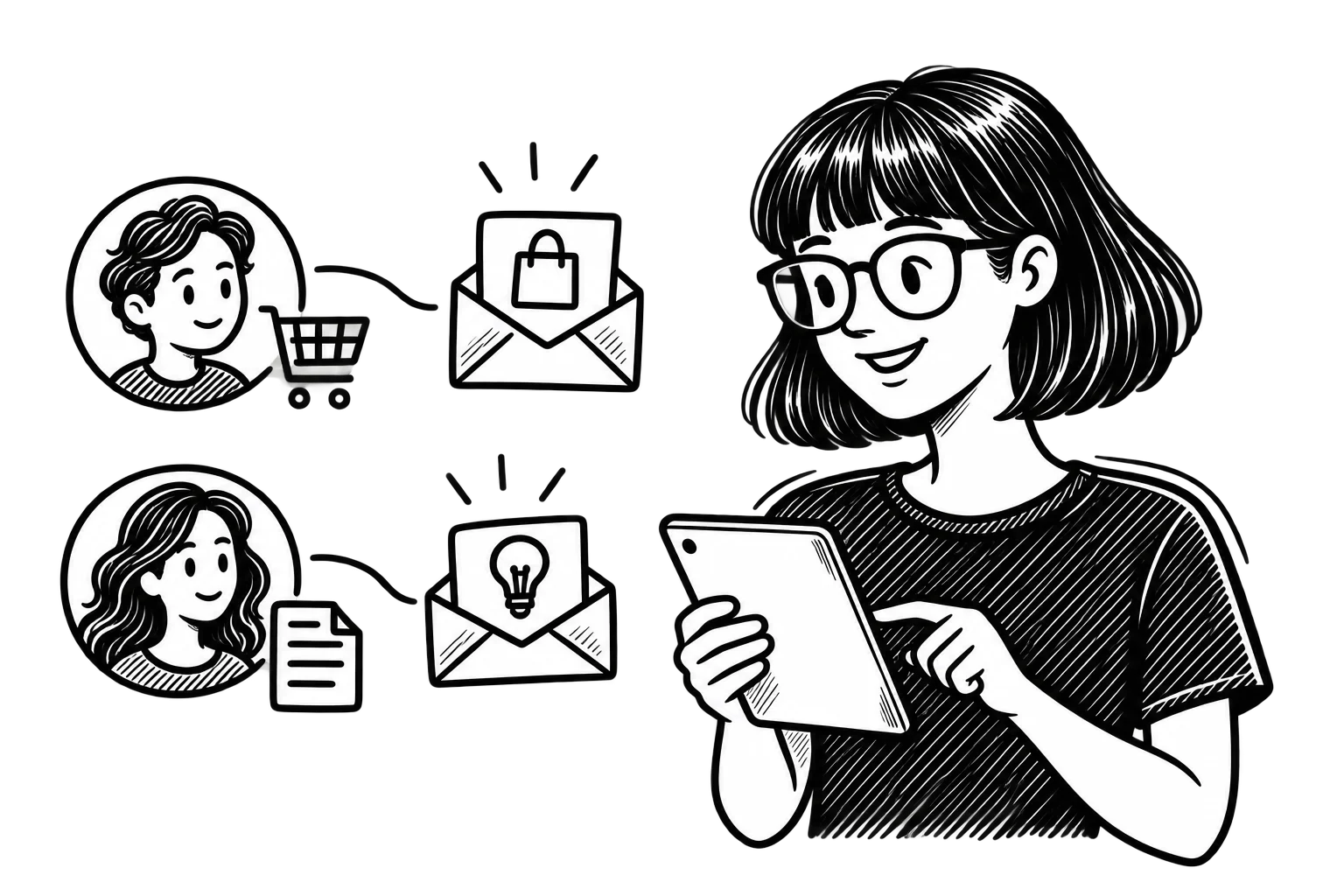
More useful personalization changes the message based on what the business knows about the subscriber.
That could include:
- Different product recommendations
- Content based on expressed interests
- Offers related to previous purchases
- Different messaging for new and returning customers
- Follow-up based on website activity
- Different content depending on customer lifecycle stage
Mailchimp, for example, can build segments using purchase history, engagement, customer behavior, and predictive information. Its current predictive analytics can also estimate things such as likelihood to purchase, churn risk, predicted next purchase timing, and customer lifetime value for eligible accounts.
That does not mean every email needs dozens of personalized variations.
Personalization is useful when the difference actually matters to the recipient.
AI Is Becoming an Analysis Tool, Not Just a Writing Tool
The first wave of AI in email marketing focused heavily on generating subject lines and copy.
Those features are still useful, but the more significant opportunity is AI’s ability to work with campaign and customer data.
Platforms can increasingly use AI to help identify:
- Customers likely to purchase
- Subscribers who may be disengaging
- Audience segments worth targeting
- Campaign performance patterns
- Content or offers that may be relevant
- Areas where a campaign could be improved
Mailchimp now includes an Analytics AI that can answer questions about campaigns, automations, audience growth, engagement, and e-commerce revenue using account data. The tool can surface patterns and recommendations while leaving the final action to the marketer.
That is an important distinction.
AI can make analysis faster.
It still needs someone to decide whether the recommendation makes sense for the business.
Our deeper guide to AI in email marketing looks specifically at how artificial intelligence can support personalization, predictive analysis, timing, and content creation.
Automation Is Becoming More Responsive
Email automation is also moving beyond rigid drip campaigns.
Traditional automation might look like this:
Send email one.
Wait three days.
Send email two.
Wait five days.
Send email three.
That structure still works for some sequences, but modern workflows can respond to what someone actually does.
A subscriber might move down one path after clicking a service link and another after ignoring it.
A customer who completes a purchase can leave a sales sequence entirely.
Someone who becomes inactive can enter a re-engagement flow.
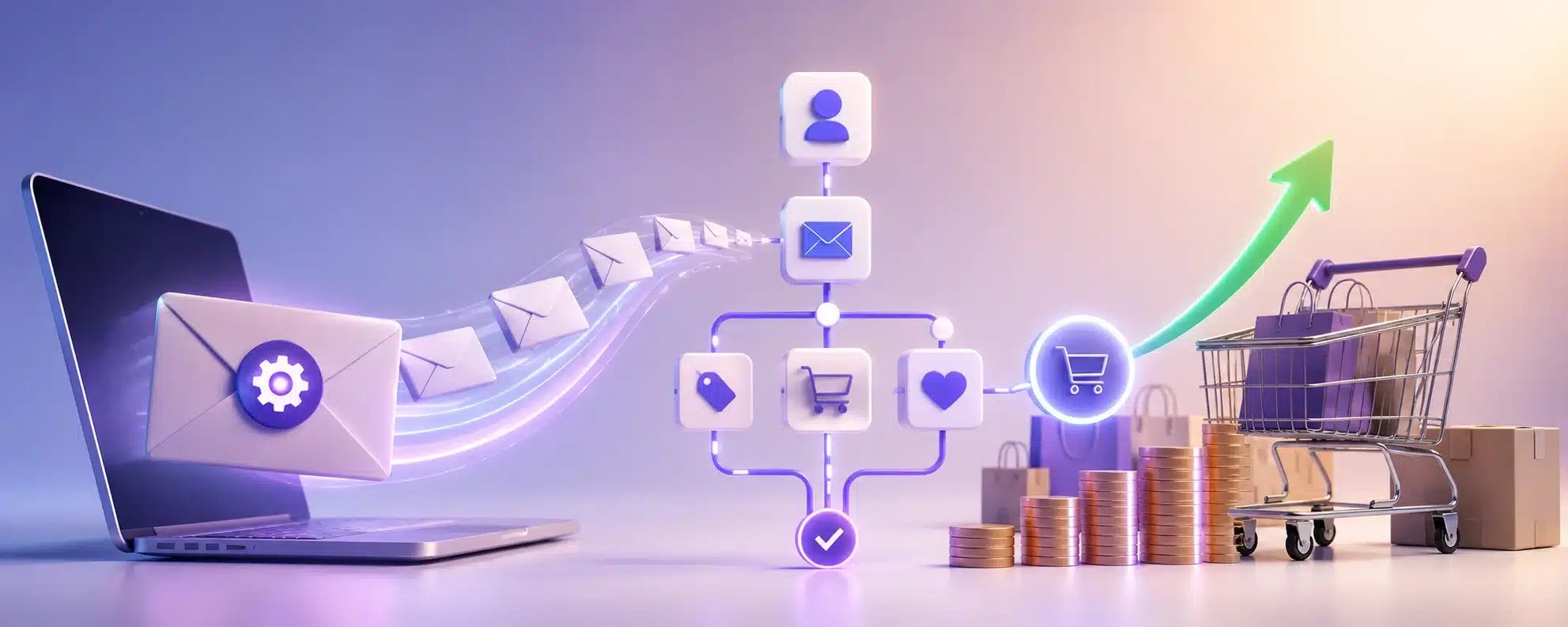
Platforms such as Mailchimp now support marketing automation flows with triggers, conditional splits, percentage splits, delays, tags, email, SMS, webhooks, and other actions.
The important trend is not automation for its own sake.
It is automation that reacts to customer behavior.
A strong email marketing automation strategy should reduce repetitive work while making the customer journey more relevant.
Email and Customer Data Are Becoming More Connected
Email used to operate somewhat separately from the rest of digital marketing.
That is changing.
The most useful email platforms increasingly connect with:
- Websites
- Online stores
- CRMs
- Forms
- Customer accounts
- Analytics
- Advertising platforms
- Customer service systems
That connection gives email more context.
Instead of knowing only that someone subscribed, the system may also know what they purchased, what they viewed, which service they asked about, or how long it has been since their last interaction.
This makes email particularly useful as part of a broader customer behavior strategy.
The more accurately the systems communicate, the easier it becomes to use email at meaningful moments instead of sending another generic campaign simply because it is Tuesday.
Deliverability Is Becoming a Marketing Responsibility
An email campaign cannot perform if the message does not reach the inbox.
Deliverability used to feel like something only technical teams or large email senders needed to worry about.
That is no longer a safe assumption.
Google’s current email sender guidelines require authentication standards for mail sent to Gmail accounts, with additional requirements for bulk senders. Senders reaching roughly 5,000 or more messages per day to personal Gmail accounts must use SPF, DKIM, and DMARC, maintain low spam rates, and support one-click unsubscribe for promotional and subscribed messages. Google increased enforcement against non-compliant traffic beginning in November 2025.
Yahoo has similar sender requirements, including authentication, low complaint rates, and easy unsubscribe requirements for bulk senders.
This means marketers need to care about:
- Authentication
- List quality
- Consent
- Spam complaints
- Unsubscribe handling
- Sending frequency
- Engagement
- Sudden changes in sending volume
Deliverability is not separate from email strategy anymore.
It is part of it.
List Quality Matters More Than List Size
Growing an email list is still useful.
Growing it at any cost is not.
Purchased lists, unclear consent, old contacts, and subscribers who never wanted the emails can damage engagement and sender reputation.
Google explicitly recommends sending to people who opted in and making it easy for recipients to unsubscribe. Yahoo similarly recommends sending relevant email only to users who specifically requested it.
That makes a smaller engaged audience potentially more valuable than a much larger disengaged one.
Businesses should think about why someone would want to join the list.
The answer might be:
- Useful information
- Product updates
- Exclusive offers
- Event announcements
- Early access
- Industry insights
- Educational resources
- Loyalty benefits
Then set expectations.
If someone signed up for a monthly newsletter, suddenly emailing them every day is unlikely to strengthen the relationship.
Permission is not simply about getting an email address.
It is about respecting what the subscriber thought they were agreeing to.
Open Rate Is Becoming Less Useful on Its Own
Open rate has traditionally been one of the first numbers marketers check after sending an email.
It still has some value, but it needs context.
Apple’s Mail Privacy Protection can privately download remote email content in the background, preventing senders from reliably knowing whether a recipient actually opened the message.
That makes open rate less dependable as a standalone measure of engagement.
More useful metrics may include:
- Click-through rate
- Conversion rate
- Replies
- Form submissions
- Purchases
- Revenue
- Bookings
- Lead quality
- Unsubscribe rate
- Spam complaints
The best metric depends on what the email was supposed to accomplish.
A newsletter designed to educate may be judged differently from an abandoned-cart automation designed to generate purchases.
The question should not simply be:
Did people open it?
It should be:
Did the email help move the customer relationship forward?
Email Funnels Are Becoming More Behavior-Driven
Email campaigns do not have to operate as disconnected sends.
Businesses are increasingly building sequences around where someone is in the relationship.
A simple customer journey might include:
- Subscriber joins the list.
- Welcome sequence introduces the business.
- Educational emails build familiarity.
- Behavior determines which content comes next.
- A relevant offer appears when interest is stronger.
- Post-conversion communication supports the customer.
- Retention emails help continue the relationship.
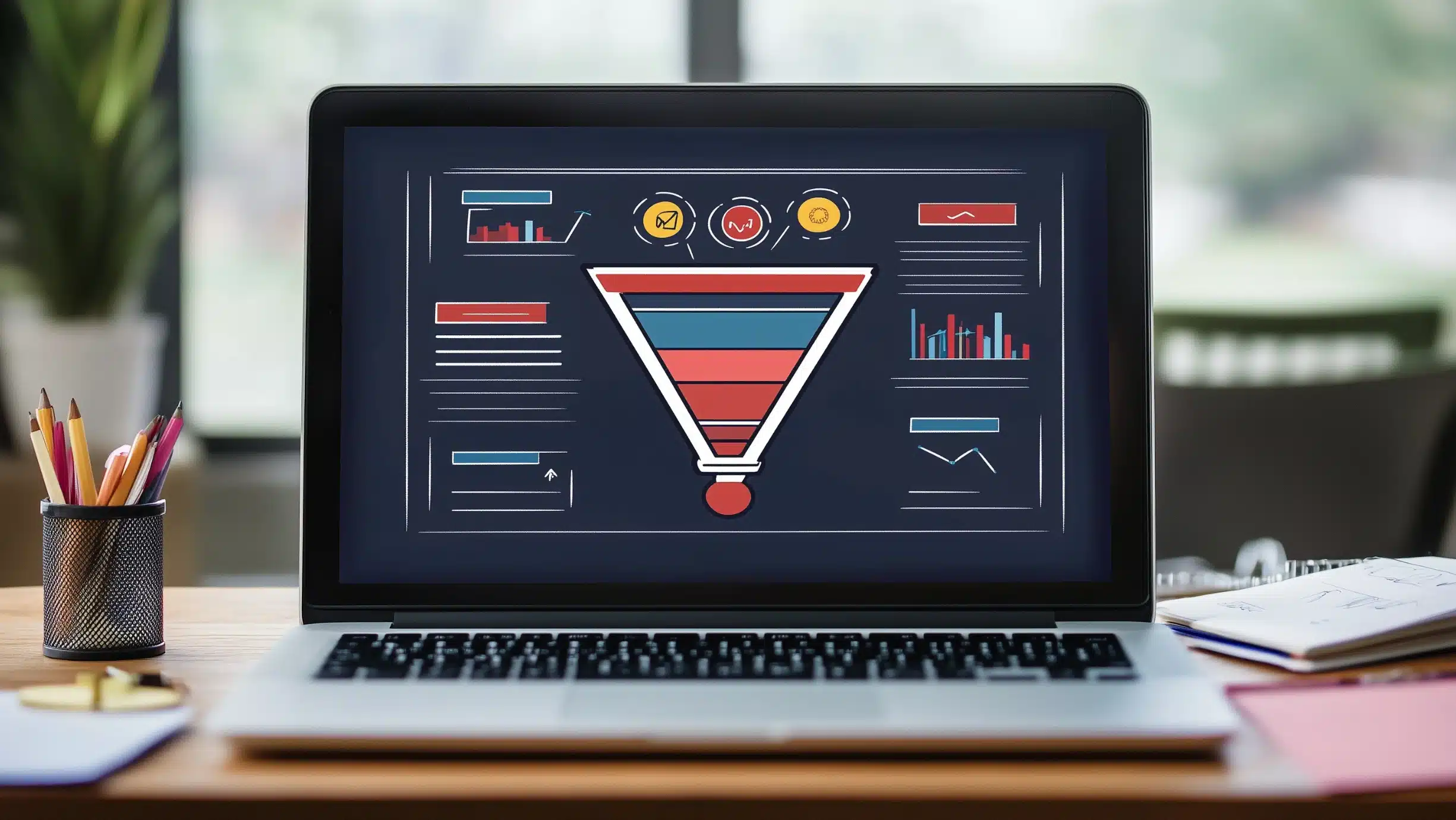
That is the role of email funnels.
The funnel gives individual emails a purpose instead of treating every send as a separate marketing event.
The exact journey will vary between a retailer, nonprofit, professional service company, and B2B organization.
What matters is that each message has a reason to exist.
Accessible Email Design Is Becoming a Baseline Expectation
Accessibility should not be treated as a design trend that comes and goes.
Emails need to work for people using different devices, screen sizes, display settings, and assistive technologies.
Basic practices include:
- Readable font sizes
- Strong color contrast
- Descriptive alt text
- Clear link text
- Logical content hierarchy
- Buttons large enough to tap
- Meaningful text outside images
- Layouts that still work when images do not load
- Testing in light and dark environments
Accessibility also tends to improve usability for everyone.
A clearly structured email is easier to scan.
Readable typography is easier to read.
Descriptive buttons are easier to understand.
The goal is not to make an email visually complicated.
It is to make the message easy to receive and act on.
Interactive Email Should Be Used Selectively
Interactive email still has useful applications.
Polls, surveys, product selectors, countdowns, and other interactive elements can create engagement when the email platform and inbox support them properly.
But I would no longer call interactive email a must-have trend.
Compatibility varies between email clients, and adding complexity can create more testing and accessibility concerns.
Often, a simple email with one clear message and one useful call to action will outperform a technically impressive email that makes the subscriber work harder.
Use interaction when it improves the experience.
Do not add it simply because the technology exists.
Human Brand Voice Matters More as AI Content Increases
AI makes it easier for businesses to create polished email copy quickly.
It also makes it easier for hundreds of businesses to sound almost identical.
That gives brand voice more value.
Email is a relatively personal channel.
People see the sender name repeatedly in the same inbox they use for coworkers, friends, customers, appointments, receipts, and other parts of daily life.
Businesses should use that familiarity intentionally.
Strong email copy should sound like the company behind it.
That may mean:
- Clearer opinions
- Real examples
- Stories from the business
- Customer questions
- Useful expertise
- Less corporate filler
- Consistent tone
AI can help draft or refine the message.
Someone still needs to decide whether the message sounds like something the business would actually say.
Testing Is Becoming More Useful Than Following Benchmarks
Industry benchmarks can provide context.
They cannot tell you exactly what your audience will respond to.
A better approach is to test meaningful variables inside your own email program.
That might include:
- Subject lines
- Send timing
- Calls to action
- Content length
- Offers
- Audience segments
- Workflow timing
- Landing pages
- Frequency
Some automation platforms now support percentage splits specifically for testing different paths or messaging inside a workflow. Mailchimp, for example, allows contacts to be divided between paths to compare different offers, timing, or email content.
Testing works best when you know what you are trying to learn.
Changing the subject line, design, offer, audience, and send time simultaneously makes it difficult to know what actually affected the result.
What Businesses Should Focus on Now
You do not need to adopt every email marketing trend at once.
Start with the foundation.
Clean your list. Remove invalid contacts and review disengaged audiences.
Check authentication. Make sure your sending domain is configured correctly.
Improve segmentation. Stop treating the entire list as one audience when meaningful differences exist.
Build useful automations. Start with moments such as welcome, follow-up, post-purchase, or re-engagement.
Use AI deliberately. Let it support analysis and efficiency without giving up review and judgment.
Measure meaningful actions. Pay attention to clicks, conversions, leads, revenue, and other outcomes that connect email to the business.
Make the email easy to use. Accessibility, mobile design, clear calls to action, and simple layouts still matter.
Respect subscriber expectations. Relevance and permission are part of performance.
Email Marketing Is Becoming More Intentional
The future of email is not about turning every message into an AI-generated, hyper-personalized interactive experience.
It is about using better information to make better decisions.
Who should receive this?
Why are we sending it?
What does the subscriber need?
What should happen next?
How will we know whether it worked?
AI, automation, segmentation, predictive analytics, and better reporting can make those questions easier to answer.
But the strongest email programs will still depend on something much simpler:
Sending useful messages to people who actually want to receive them.