How to Use Data to Predict Customer Behavior
How to Use Data to Predict Customer Behavior
Customer data can help you identify who is likely to buy again, disengage, or respond to a specific offer. Learn how to turn behavioral patterns into useful predictions and better marketing decisions.


Customer data can tell you much more than what happened last month.
Used well, it can help you identify patterns that suggest what customers may do next.
Which customers are likely to purchase again? Who is becoming less engaged? Which products tend to lead to another purchase? Which prospects appear closer to converting?
That is the idea behind predictive customer behavior analysis.
It is not about knowing the future with certainty. It is about using patterns in past and current behavior to estimate what is more likely to happen next, then using that information to make a better decision.
And increasingly, businesses do not need a team of data scientists to start doing it.
Analytics, e-commerce, CRM, advertising, and email platforms are building predictive capabilities directly into the tools businesses already use.
What Does It Mean to Predict Customer Behavior?
Predictive customer behavior analysis uses historical and current customer data to estimate the likelihood of a future action.
That action might be:
- Making another purchase
- Becoming a high-value customer
- Abandoning a purchase
- Responding to a campaign
- Becoming inactive
- Canceling a subscription
- Purchasing a related product
- Returning within a particular period
The important word is likelihood.
A predictive model does not tell you that a specific customer will definitely purchase next Tuesday.
It identifies patterns that suggest some customers are more likely to take a particular action than others.
That distinction matters because predictions are most useful for prioritization.
If one group appears significantly more likely to purchase again, you might market to that group differently.
If another group shows signs of disengagement, you may decide to reconnect before those customers disappear completely.
Start With a Business Question, Not a Data Dashboard
One of the easiest ways to make customer analytics unnecessarily complicated is to start by collecting everything.
Instead, begin with one question.
For example:
Which customers are most likely to purchase again?
Which subscribers are showing signs of disengagement?
Which leads are most likely to become customers?
Which products tend to lead to a second purchase?
A specific question helps determine which data actually matters.
If you are trying to predict repeat purchases, order history and purchase frequency may matter more than social engagement.
If you are trying to identify leads likely to convert, form activity, website behavior, CRM stage, and previous conversations may be more useful.
Good predictive analytics starts with the decision you are trying to improve, not with the amount of data you can collect.
Use the Customer Data You Already Have
Many businesses already collect useful behavioral information without thinking of it as predictive data.
The challenge is connecting it.
Transaction Data
Purchase history is one of the clearest behavioral signals.
Useful information can include:
- Number of purchases
- Average order value
- Products purchased
- Time between purchases
- Last purchase date
- Discounts used
- Returns
- Lifetime spend
Patterns in that information can help distinguish a first-time customer from someone who purchases consistently or someone whose buying activity is beginning to decline.
Website and App Behavior
Your web analytics can show what people do before they convert.
That might include:
- Pages viewed
- Products viewed
- Return visits
- Add-to-cart activity
- Checkout starts
- Key events
- Downloads
- Form submissions
- Content engagement
Do not treat every page view as equally meaningful.
Someone visiting your homepage once is giving you a much weaker signal than someone who returned three times, viewed a pricing page, and started filling out a consultation form.
Behavior needs context.
Email and Marketing Engagement
Email activity can also reveal changing interest.
Useful signals might include:
- Links clicked
- Topics engaged with
- Purchases following email
- Offers used
- Frequency of engagement
- Time since the last meaningful interaction
Be careful with open rates as a primary signal because privacy features can make them less reliable.
Actions such as clicks, purchases, registrations, and replies usually provide stronger behavioral information.
Customer Service and Sales Data
Some of the most useful customer data never appears in Google Analytics.
Sales conversations, support requests, chat transcripts, CRM notes, objections, cancellations, and frequently asked questions can reveal patterns that quantitative dashboards miss.
For a service business, knowing why a lead did not close can be just as valuable as knowing which page they visited.
For an e-commerce business, repeated support questions may reveal friction that affects repeat purchases.
First-Party Data Matters More as AI Gets Better
Predictive tools depend on the information they receive.
That makes first-party data, information collected through your own customer relationships, particularly valuable.
It may include:
- Purchases
- Website events
- CRM records
- Email engagement
- Form submissions
- Customer accounts
- Loyalty activity
- Support interactions
AI can analyze those signals much faster than a person working through spreadsheets manually.
But better AI does not make poor data better.
Duplicate customer records, incorrect conversions, missing purchases, outdated CRM stages, and inconsistent tracking can all lead to poor conclusions.
Before asking AI to find patterns, make sure the underlying data is worth analyzing.
You Can Start With Segmentation Before Predictive Modeling
Not every business needs a sophisticated machine-learning model.
Simple segmentation can reveal useful behavioral patterns.
For example, an online store might create groups such as:
Recent repeat customers
Purchased at least twice and ordered within the last 90 days.
High-value customers
Spend or lifetime value exceeds a meaningful threshold.
At-risk customers
Previously purchased regularly but have gone significantly longer than usual without another order.
Engaged non-buyers
Repeatedly visit product or service pages but have not converted.
Those are not necessarily machine-learning predictions.
But they can still help you identify behavior that suggests what may happen next.
More sophisticated prediction becomes useful when the platform has enough data to recognize patterns that would be difficult to define manually.
Google Analytics Can Generate Predictive Metrics
Google Analytics includes predictive metrics that use machine learning to estimate certain future behaviors when a property meets Google’s data requirements.
Current predictive metrics include:
- Purchase probability
- Churn probability
- Predicted revenue
- In-app purchase probability
For example, purchase probability estimates whether an active user is likely to trigger a relevant purchase event within the next seven days. Google Analytics can also use those predictions to create audiences such as likely purchasers or predicted top spenders.
This can help businesses move from analyzing only what users already did to identifying audiences that may deserve attention next.
There is an important limitation, however.
Not every Google Analytics property qualifies.
Google needs sufficient eligible event data and acceptable model quality before predictive metrics become available. If the property does not have enough usable information, the predictions may not be generated.
That is another reason accurate event tracking matters.
Shopify Can Predict Customer Spending Potential
E-commerce platforms are also bringing predictive capabilities closer to smaller merchants.
Shopify’s predicted spend tier estimates customers’ future spending potential based on signals such as purchase frequency, average order value, number of orders, and how recently they purchased.
Shopify categorizes qualifying customers into high, medium, or low predicted spend tiers.
A store could then use those groups to identify higher-value customers or build more targeted segments.
There are requirements.
Shopify currently requires a store to have more than 100 sales before predicted spend tiers are available, and only customers who have already made a purchase are included. (help.shopify.com)
That is a useful example of how prediction actually works in practice.
More data does not automatically mean better prediction, but a model does need enough meaningful behavior to identify patterns.
Look for Patterns That Lead to an Action
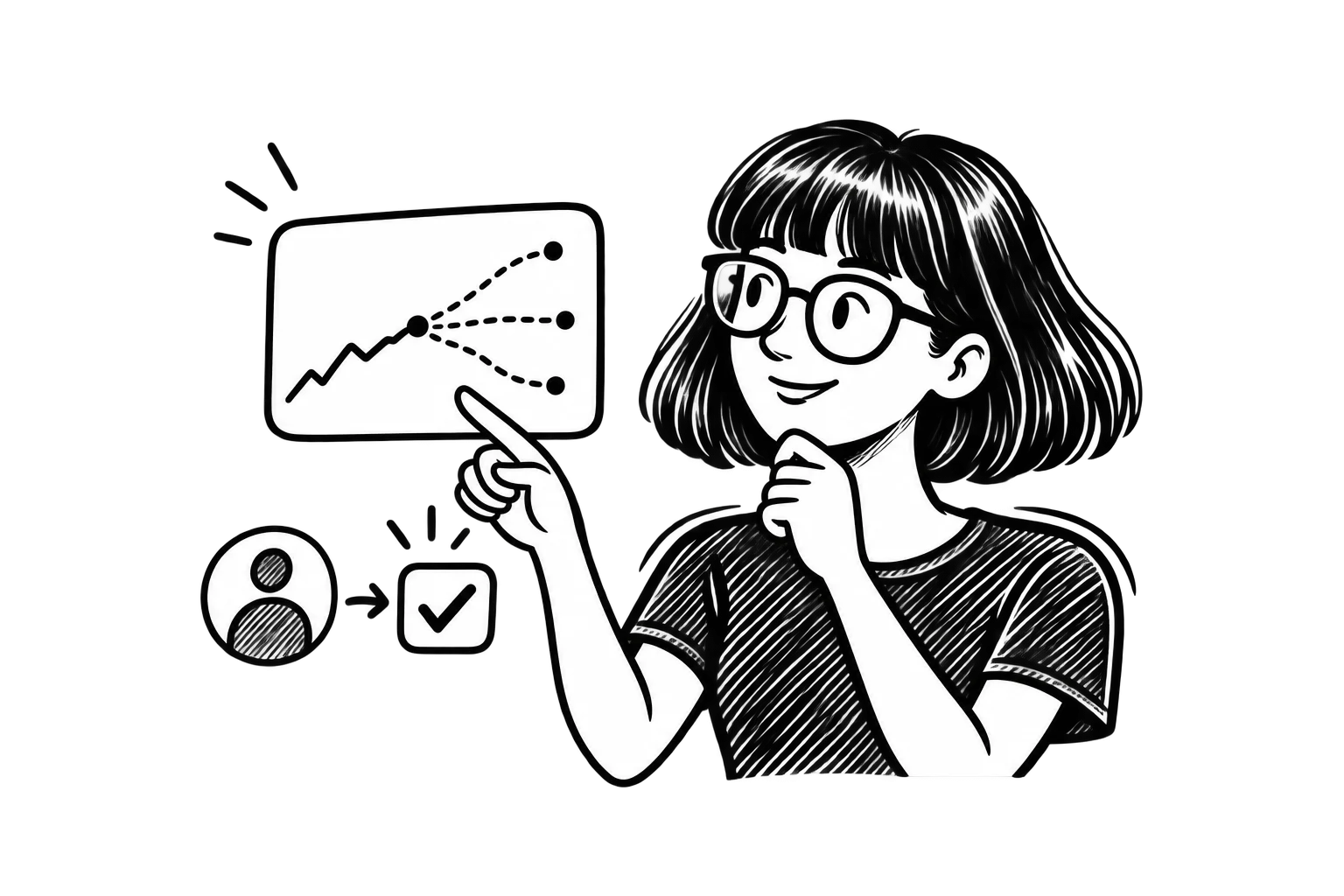
Once the data is organized, ask what tends to happen before the outcome you care about.
Suppose you want to predict repeat purchases.
You might discover that customers who:
- Buy a particular starter product
- Return to the website within two weeks
- Click a specific educational email
- Purchase again within 45 days
are more likely to become repeat customers.
That pattern gives you something useful to test.
Maybe the business begins sending that educational content automatically after the first purchase.
Maybe it recommends the common second product at the right time.
Maybe it builds an email funnel around the behavior customers already demonstrate.
The prediction itself is not the goal.
The action it informs is.
Predict Churn Before the Customer Disappears
Prediction is particularly useful for retention because customer loss often has warning signs.
Those signals may include:
- Longer periods between purchases
- Reduced product usage
- Fewer website visits
- Lower email engagement
- Repeated support issues
- Subscription changes
- Fewer orders
- Decreasing order values
No single signal necessarily means a customer is leaving.
The pattern matters.
If customers historically purchased every 30 days and someone has now gone 90 days without ordering, that customer may deserve different communication from someone who purchased for the first time last week.
A retention campaign could provide useful reminders, education, support, product recommendations, or an incentive when appropriate.
The goal is to respond before the relationship disappears completely.
Predict Purchase Intent Without Treating Every Visitor the Same
Not every website visitor is equally close to making a decision.
Someone reading an introductory blog article may be researching broadly.
Someone repeatedly visiting the same service page, checking pricing information, and returning through a branded search may be showing stronger intent.
That does not mean you know exactly what that person will do.
It means their behavior gives you more information.
Businesses can use that difference to:
- Build remarketing audiences
- Prioritize sales follow-up
- Adjust lead scoring
- Trigger relevant email sequences
- Personalize recommendations
- Test different offers
This is much more useful than treating everyone who visited the website as one generic audience.
AI Makes Analysis Faster, but It Still Needs Context
AI tools can help businesses analyze larger amounts of customer information than they could reasonably review manually.
Shopify describes current AI customer insights as patterns and predictions generated from data such as purchases, browsing activity, support conversations, and email engagement.
That can make questions such as these easier to explore:
- Which customer groups are becoming more valuable?
- What behaviors often happen before a repeat purchase?
- Which products frequently appear together?
- What complaints occur most often among customers who churn?
- Which channels bring customers with higher lifetime value?
But AI does not automatically understand the business context behind every pattern.
Correlation does not always mean causation.
A group may appear more valuable because of seasonality, a promotion, a geographic difference, or another factor the system has not interpreted correctly.
Use AI to surface patterns.
Then investigate whether those patterns make business sense.
Do Not Collect Data Just Because You Can
Predictive marketing creates a temptation to collect as much customer information as possible.
More is not always better.
Collect the information you have a legitimate reason to use, understand where it is stored, control who can access it, and remove information you no longer need.
The Federal Trade Commission advises businesses to collect only the data they need and retain sensitive information only as long as there is a legitimate business reason to keep it.
Businesses also need to follow the privacy and consent requirements that apply to their customers, locations, platforms, and industry.
A prediction is not valuable enough to justify careless data practices.
Customer trust is part of the equation too.
Test Whether the Prediction Actually Helps
A predictive model can sound impressive without improving the business.
The real test is whether acting on the prediction produces a better outcome.
Suppose your system identifies customers likely to purchase again.
Create a test.
One group receives the targeted campaign.
A comparable group does not.
Then evaluate whether the campaign actually increased:
- Repeat purchases
- Revenue
- Retention
- Average order value
- Qualified leads
- Conversions
This prevents a common analytics mistake: assuming that because a model identified a pattern, acting on that pattern automatically creates value.
Measurement still matters.
Ultimately, marketing ROI depends on whether the prediction helps the business make better decisions, not how sophisticated the dashboard looks.
A Practical Process for Predicting Customer Behavior
You do not need to begin with a complicated data science project.
1. Choose One Behavior
Start with something meaningful:
- Repeat purchase
- Churn
- Lead conversion
- Product interest
- Customer value
2. Identify the Relevant Data
Determine which signals might help explain that behavior.
Do not collect unrelated information simply because it is available.
3. Clean and Connect the Data
Make sure important events are being recorded correctly and customer information is not unnecessarily fragmented across systems.
4. Start With Observable Segments
Look for simple behavioral differences before jumping into advanced prediction.
You may discover enough information to improve your marketing immediately.
5. Use Predictive Tools When the Data Supports Them
If Google Analytics, Shopify, your CRM, email platform, or another system offers predictive capabilities and you meet the requirements, test them.
6. Take a Specific Action
A prediction should lead to something:
A campaign.
A recommendation.
A sales follow-up.
A retention effort.
An inventory decision.
7. Measure the Result
Did acting on the prediction improve the outcome?
If not, change the model, the segment, or the action.
Predictive Customer Data Should Lead to Better Decisions
Predictive analytics is becoming more accessible because AI and machine learning are increasingly built into everyday business platforms.
But the basic principle has not changed.
You need useful data.
You need a clear question.
You need enough history to recognize meaningful patterns.
And you need a way to act on what you learn.
The goal is not to predict every customer’s next move.
It is to reduce uncertainty enough to make better decisions about who to reach, when to reach them, and what they may need next.
When customer data helps you do that, prediction becomes more than another analytics feature.
It becomes a practical part of your marketing strategy.