Hyperlocal Marketing: How to Reach Customers in Your Neighborhood
Hyperlocal Marketing: How to Reach Customers in Your Neighborhood
Hyperlocal marketing helps small businesses reach customers in specific neighborhoods. Learn how to improve local search visibility, create relevant neighborhood content, use geographic advertising, and measure meaningful results.


A neighborhood coffee shop does not need to reach everyone in its city. It needs to be easy to find when someone nearby wants coffee before work. The same principle applies to a salon, bookstore, restaurant, or service business with a defined local market.
Hyperlocal marketing focuses on customers in a specific neighborhood, commercial district, or small service area. It combines local search visibility, relevant content, geographically focused advertising, and community relationships. The goal is to become a useful, recognizable option where your customers actually live, work, or spend time, not to reach the largest possible audience.
Here is how to put that approach into practice without assuming a smaller geographic target automatically guarantees better results.
What Is Hyperlocal Marketing?
Local marketing can target an entire city or region. Hyperlocal marketing narrows the focus to a smaller area, such as the streets around a storefront, a neighborhood where a contractor regularly works, or a specific shopping district.
That narrower focus only makes sense when it matches your customers’ behavior. A walk-in bakery may care about customers within a short trip. A home service company might serve several distinct neighborhoods that are miles apart. In either case, start by defining where customers can realistically buy from you, not by choosing an arbitrary radius on a map.
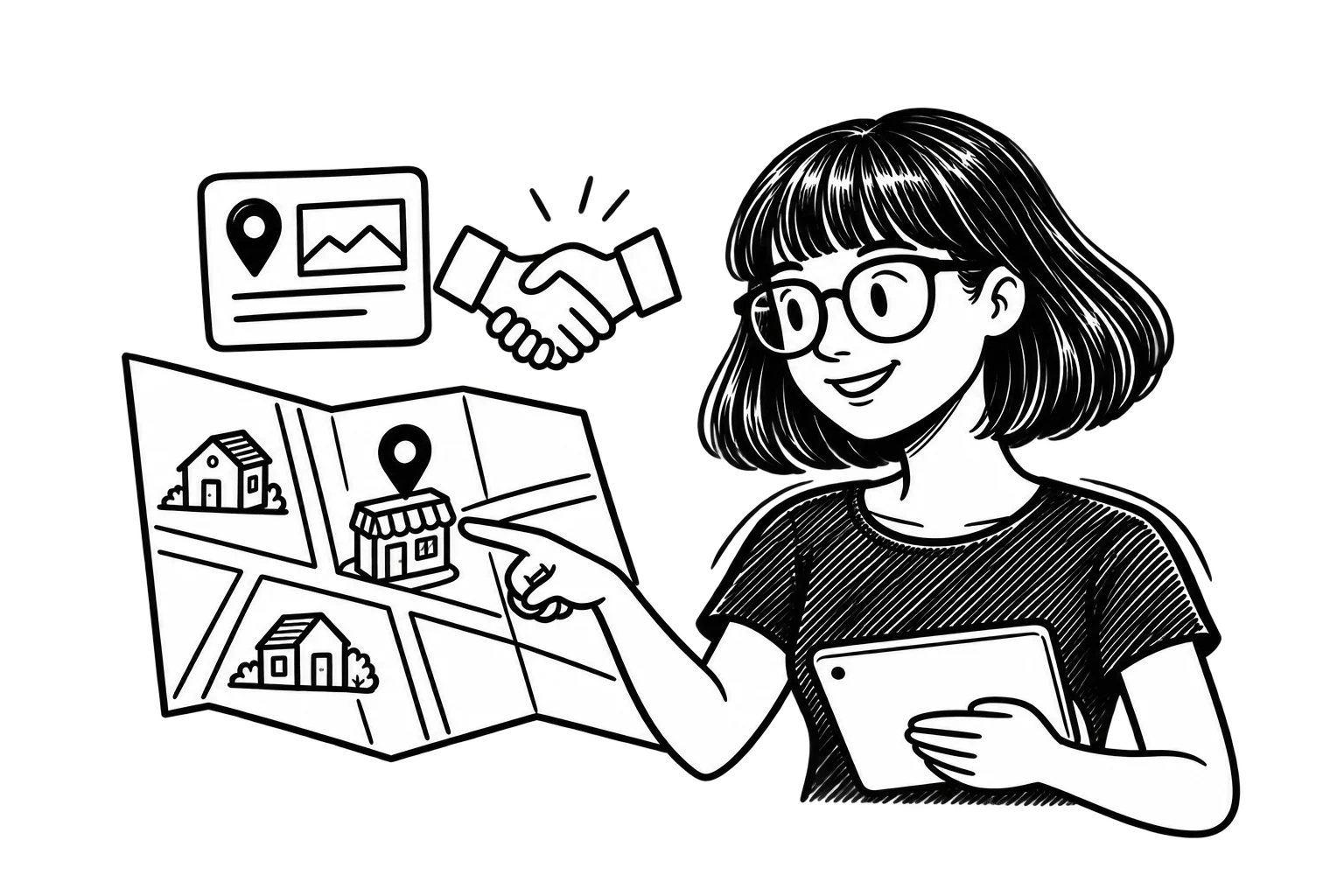
Hyperlocal marketing also goes beyond paid ads. An accurate Google Business Profile, a helpful neighborhood guide, a partnership with another local business, and a well-timed event can all make your business more relevant to nearby customers.
Build a Reliable Local Search Presence First
Before paying to reach more people, make sure someone who finds your business can confirm that you are open, nearby, and able to help.
Keep Your Google Business Profile Accurate
For eligible businesses, Google Business Profile is a central part of local discovery on Search and Maps. Confirm the business name, primary category, hours, phone number, website, and address or service area. Add useful photos showing what customers can expect, and keep holiday hours current.
Google explains that local results are mainly influenced by relevance, distance, and prominence in its guidance on local ranking. Completing a profile helps Google understand the business; it does not guarantee that you will rank first for every nearby search.
For example, a bookstore promoting an author event should make sure its hours and event details are easy to find. A customer deciding where to go on Saturday needs reliable information more than another generic post about loving books.
If you travel to customers instead of serving them at a storefront, follow Google’s rules for service-area businesses. A business operating from a private home generally should not display that address if customers are not served there. Creating listings for nonexistent offices is not a legitimate way to appear in more neighborhoods.
Make Reviews Part of the Customer Experience
Ask customers for honest feedback and respond professionally to reviews when appropriate. Reviews can help people decide whether your business fits their needs, especially when they are comparing several nearby options.
Google permits businesses to share a review link or QR code, but its review policies prohibit incentives in exchange for reviews. Do not offer discounts for positive ratings or selectively pressure customers to leave only favorable feedback.
Create Content That Reflects the Neighborhood
People have practical reasons to search for nearby businesses. They want to know whether you serve their area, what is available, how to get there, and whether you understand what matters locally.
Useful content can answer those questions directly:
- A restaurant could explain its pickup options near a busy office district.
- A gym could share nearby walking or running routes that its members actually use.
- A home service company could explain the neighborhoods it serves and common questions about scheduling there.
- A retailer could highlight a genuine collaboration with another neighborhood business.
Use neighborhood names where they help the reader, not as decoration. A page that swaps one neighborhood name for another without offering different, useful information is unlikely to help customers.
If your business has multiple real locations, give each one a useful location page with accurate contact details, hours, services, and directions. If you serve several areas from one location, explain your service coverage honestly rather than implying that you have storefronts where you do not.
This fits into a broader local SEO strategy for growing businesses. Hyperlocal content should support your actual services and customer questions, rather than become a collection of thin pages built around neighborhood keywords.
Use Geographic Advertising Without Overpromising Precision
Location-based advertising can be useful when you need to promote a limited-time offer, introduce a new location, or test demand in an area you can serve.
A geofence refers to a defined geographic boundary. Some advertising systems support radius or location targeting, but creating a geofence does not automatically send a notification to every phone that crosses it. Whether someone sees an ad depends on the advertising platform, its location signals, eligibility, campaign settings, and delivery conditions.
In Google Ads, for example, the default geographic option can include people who show interest in a targeted location even if they are not physically there. Google’s location targeting guidance explains the distinction between Presence or Interest and Presence, which focuses on people likely to be in or regularly in the target area. Neither setting offers perfect location accuracy.
For a small business, a practical test might look like this:
- Choose one area where customers can realistically visit or book your service.
- Promote one clear offer that fits the neighborhood and your business goals.
- Send people to a relevant page with the correct location, hours, and next action.
- Track meaningful outcomes such as inquiries, bookings, or redemptions, not only clicks.
Do not assume the smallest available radius is the best choice. A tiny audience may limit delivery, and targeting a competitor’s entrance does not necessarily reach people interested in your business.
If you are deciding where to put a limited budget, this comparison of local SEO and paid local ads explains the tradeoffs between building long-term visibility and buying short-term exposure.
Participate in the Community Online and Offline
Being part of a neighborhood is not the same as targeting it in an advertising dashboard. Local relationships can help people recognize and remember your business in ways a one-off promotion cannot.
Join neighborhood conversations when you have something useful to contribute. Answer an appropriate question in a local group, share a relevant event, or highlight another business you genuinely recommend. Follow group rules and avoid treating community spaces like free advertising inventory.
Offline efforts matter, too. A coffee shop and a nearby bakery might collaborate on an event. A retailer could participate in a neighborhood festival. A service company might offer a practical workshop with a community organization.
These examples are options to evaluate, not guaranteed growth tactics. Choose partnerships that fit your audience, resources, and community rather than sponsoring every event on the calendar.
Measure Whether Your Neighborhood Strategy Is Working
A campaign can reach the right ZIP code and still fail to bring in customers. Measurement should help you distinguish visibility from business results.
Start with a baseline: how many relevant calls, booking requests, directions requests, or local purchases are you getting now? If you need free tools to establish that baseline, our guide to how to rank on Google without a big budget covers Google Search Console and Google Business Profile. Then evaluate the channels you actually used. Consider:
- Google Business Profile interactions and the questions customers ask.
- Visits to specific location or service pages.
- Bookings, purchases, and qualified inquiries from the area.
- Coupon redemptions or event registrations when you can identify the campaign.
- Staff feedback about how new customers heard of the business.
Use consistent campaign URLs where possible, but avoid pretending that every in-store visit can be traced to one social post or ad. Direction requests and profile views indicate interest; they are not the same as completed sales.
A useful review question is not just “Did traffic go up?” It is “Did more relevant customers take an action worth the time and money we invested?”
A Simple 30-Day Hyperlocal Marketing Plan
You do not need to launch every tactic at once. A focused first month gives you something concrete to evaluate.
- Week 1: Define the area. Identify your most relevant neighborhoods using customer addresses, purchase patterns, service coverage, or conversations with customers. Check your Google Business Profile for inaccurate information.
- Week 2: Improve discovery. Update hours and photos, make contact details easy to find, and request honest reviews from customers without incentives.
- Week 3: Publish something locally useful. Create one neighborhood-focused page, post, or event update that answers a real customer question. Start one genuine community conversation or partnership.
- Week 4: Review and adjust. Compare inquiries, bookings, or visits with your baseline. If a paid campaign makes sense, test a small geographic area with a clear budget and measurable goal.
The strongest neighborhood strategy is not necessarily the most sophisticated. It is the one that helps nearby customers understand what you offer, trust the information they find, and take the next step without friction. Start close to home, measure what changes, and expand only when the evidence supports it.