Resources SEO for growing businesses: what actually works
SEO for growing businesses: what actually works
SEO for growing businesses: what actually works
Most small businesses are invisible on Google. Not because they have bad products or services. Because they’ve never given Google a reason to show them.
The good news is that reason doesn’t cost as much as you think. It costs consistency, clarity, and a basic understanding of how search actually works.
This guide cuts through the noise. No jargon, no agency-speak, no strategies that require a team of five to execute. Just what SEO actually is, what it takes to rank, and how to build a strategy that works for a business your size.

What SEO actually is
Search engine optimization is the practice of making your website easier for Google to find, understand, and recommend. That’s it. Everything else is detail.
When someone types a question into Google, the search engine scans billions of pages and tries to return the most relevant, trustworthy, and useful result. SEO is the work you do to make sure your page is the one that comes up.
Three things determine whether Google recommends your page: relevance, authority, and technical quality. Most small businesses ignore all three. The ones that pay attention to all three tend to win.
SEO takes time. Most businesses start seeing meaningful movement between three and six months after making consistent changes. The ones that stick with it are the ones that eventually dominate their category.
Local vs national: pick your battle
Before you do anything else, you need to decide whether you’re trying to rank locally or nationally. This is the most important strategic decision in SEO, and most small businesses get it wrong by never actually making the decision.
When local SEO is the right choice
If your customers have to physically come to you, or if you go to them within a specific geographic area, local SEO is where your energy belongs. A dentist in Louisville, a plumber in Phoenix, a restaurant in Miami. The customer is nearby. The search is location-based. And Google knows it.
Local SEO means optimizing your Google Business Profile, getting listed in local directories, collecting reviews, and making sure your address and phone number appear consistently across the web. It’s highly actionable and produces results faster than national SEO for most small businesses.
When national SEO makes sense
If you sell online, offer remote services, or serve customers across multiple states, national SEO becomes relevant. But this is a harder, longer, more competitive game. You’re no longer competing with the other three dentists in your zip code. You’re competing with every website that has ever written about your topic.
Most small businesses that try to rank nationally before they’ve established local authority waste time and money. The smarter path is to dominate locally first, build authority in your specific market, and expand from there.
How Google decides who ranks
Google uses over 200 ranking factors. You don’t need to know all of them. You need to understand the handful that matter most for a small business with limited time and budget.
Keywords and search intent
Keywords are the words and phrases people type into Google. But the keyword alone is not enough. Google cares about intent, which is what the person is actually trying to accomplish with that search.
Someone searching “best running shoes” is in research mode. Someone searching “buy running shoes size 10 near me” is ready to purchase. Someone searching “how to break in running shoes” wants information. The same product, three completely different intents. Your content needs to match the intent, not just the keyword.
Content quality
Google has gotten very good at recognizing content that was written to rank versus content that was written to help. Thin pages, generic answers, and content that doesn’t actually address what the searcher was looking for get filtered out. Content that answers questions thoroughly, specifically, and clearly tends to rise.
This doesn’t mean long for the sake of long. A 500-word page that fully answers a specific question will outperform a 3,000-word page that rambles. Specificity beats volume.
Backlinks and authority
When other credible websites link to yours, Google interprets that as a vote of confidence. The more high-quality sites that link to you, the more authority your site builds. This is why getting featured in local press, industry publications, or relevant blogs matters. It’s not just PR. It’s an SEO signal.
Technical health
Your site needs to load quickly, work on mobile devices, and have a clear structure that Google can crawl. A slow site with broken links and confusing navigation is a site Google will not recommend regardless of how good the content is. This is the baseline, and it needs to be right before anything else matters.
Building your SEO strategy
You don’t need an agency to build an SEO strategy. You need a clear starting point and a consistent process. Here’s how to do it without wasting time on things that don’t move the needle.
1. Audit what you already have
Before creating anything new, look at what exists. Does your site load in under three seconds? Is it mobile-friendly? Do your pages have title tags and meta descriptions? Are there broken links? Tools like Google Search Console, which is free, will show you exactly where your site stands and what Google already sees.
2. Define your target keywords
Start with what your customers actually search for, not what you think sounds good. A customer looking for a marketing agency in Louisville might search “marketing agency Louisville” or “digital marketing help small business Kentucky.” They are probably not searching “integrated communications partner.” Use plain language.
Google’s free Keyword Planner, along with Search Console, will show you what searches are bringing people to your site and what related terms have volume. Start with five to ten keywords that are specific, relevant, and realistic for your current authority level.
3. Create content that answers real questions
Each page of your site should have a clear purpose and target a specific keyword or search intent. Your homepage is not enough. You need service pages, location pages if you serve multiple areas, and blog content that addresses the questions your customers ask before they buy.
One useful post that genuinely answers a question your customer is already asking is worth more than ten generic posts that exist only to add content. Think about the last five questions a customer asked you before signing a contract. Each one of those is a blog post.
4. Build your Google Business Profile
If you serve local customers, your Google Business Profile is the most important SEO asset you have outside of your website. Fill out every field. Add photos. Respond to every review. Post updates regularly. And make sure your business name, address, and phone number match exactly what appears on your website and every other directory where you’re listed.
5. Be consistent
SEO is not a project. It’s a practice. Publishing one great post and then going quiet for four months will not produce results. Updating your site, adding content, earning new mentions, and maintaining your technical health are ongoing activities. Pick a cadence you can actually sustain, even if it’s one new piece of content per month, and stick to it.
SEO in Spanish
If your business serves Spanish-speaking customers, or if you want to reach Hispanic audiences in the US, Spanish-language SEO is not optional. It’s an opportunity that most businesses are completely ignoring.
The common mistake is treating Spanish SEO as a translation of English SEO. It’s not. Spanish-speaking consumers search differently. They use different phrases, different levels of formality, and sometimes mix Spanish and English in the same search. A direct translation of your English keywords will not capture how your Hispanic customers actually look for you.
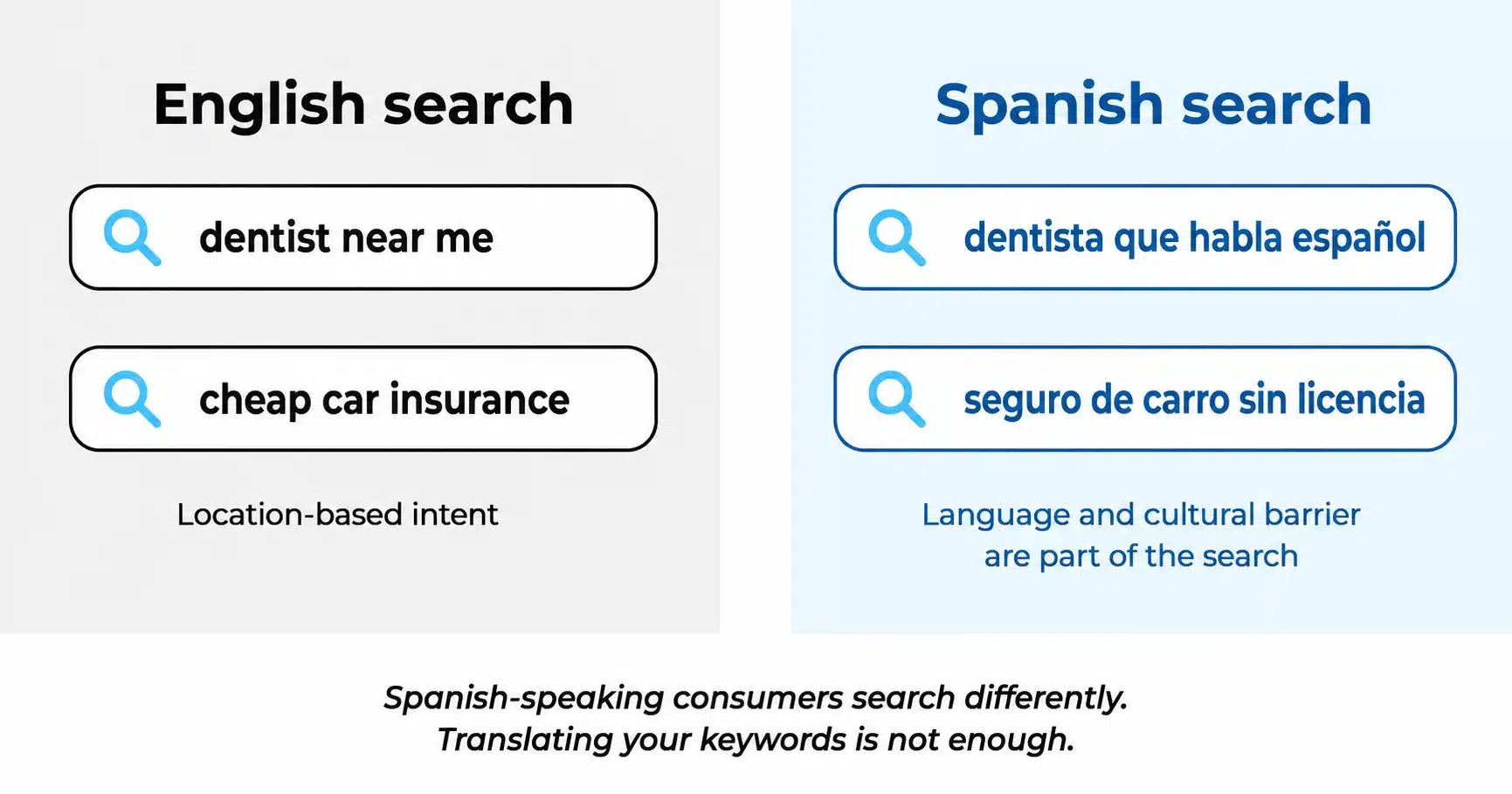
Beyond keywords, Spanish-language content signals to Google that you serve this audience. It builds trust with Hispanic consumers who prefer to research and buy in Spanish. And because so few businesses invest in it, the competition is dramatically lower than in English.
What GEO is and why it matters now
Something is changing in how people search. A growing number of users are skipping Google entirely and asking AI tools like ChatGPT, Perplexity, and Google’s own AI overview for answers. Instead of getting ten blue links, they get a single synthesized response.
This shift is creating a new discipline called generative engine optimization, or GEO. And while it’s newer and less established than traditional SEO, it’s already relevant for businesses that want to stay ahead.
The principles of GEO overlap significantly with good SEO. Clear, authoritative, well-structured content that genuinely answers questions is what both Google and AI systems reward. But GEO also emphasizes a few things that traditional SEO didn’t prioritize as heavily: being cited by other credible sources, having a clear and consistent brand identity that AI can recognize, and creating content that is easy for AI to summarize and attribute.
The businesses investing in GEO now are the ones that will have a meaningful advantage as AI-driven search continues to grow.
Common SEO mistakes
The mistakes that keep small businesses from ranking are almost always the same. And almost all of them come from trying to shortcut a process that doesn’t have shortcuts.
Targeting keywords that are too broad. Trying to rank for “marketing agency” as a small business is like trying to compete in the Olympics after a week of training. You need to start specific. “Marketing agency for small businesses in Louisville” is winnable. “Marketing agency” is not.
Publishing content and never updating it. Google favors fresh, current content. A post you wrote in 2021 and never touched since is telling Google that you’re not actively maintaining your site. Update your best-performing content regularly. Fix outdated information. Add new data.
Ignoring mobile performance. More than half of all searches happen on mobile devices. A site that looks fine on desktop and breaks on a phone is losing more than half its potential traffic. Google also uses mobile-first indexing, meaning it evaluates the mobile version of your site first when determining rankings.
Collecting reviews and ignoring them. Reviews are a significant local SEO signal. Getting them matters. Responding to them, including the negative ones, matters just as much. A business that responds thoughtfully to a negative review signals to Google and to potential customers that it takes its reputation seriously.
Expecting results in thirty days. SEO timelines frustrate people who are used to the instant feedback of paid advertising. But the traffic that SEO generates is far more durable. A well-ranking page can bring you customers for years without ongoing ad spend. The patience required upfront pays off in the long run.
Each of these mistakes has the same underlying cost: you’re working against Google instead of with it. The fix is not complicated. It’s mostly about doing the basics consistently and patiently.
Frequently asked questions
Where to go from here
SEO is one of the few marketing channels where consistent effort compounds over time. Every piece of useful content you publish, every review you earn, every credible site that mentions you is an asset that keeps working long after you created it.
The businesses that win at SEO are not the ones with the biggest budgets. They’re the ones that show up consistently, answer questions clearly, and build trust with both Google and their customers over time.
Show up consistently. Answer questions clearly. Build trust slowly.

Patricia Franco
Account Manager & Digital Strategist
Patricia is a digital strategist with 8+ years of experience helping startups and growing businesses maximize their marketing budgets through data-driven strategies. She specializes in SEO, website optimization, and performance-focused digital marketing. Bilingual EN/ES.
SHARE
Patricia Franco
Account Manager & Digital Strategist
Patricia is a digital strategist with 8+ years of experience helping startups and growing businesses maximize their marketing budgets through data-driven strategies. She specializes in SEO, website optimization, and performance-focused digital marketing. Bilingual EN/ES.
RELATED ARTICLES