Resources Marketing Strategy for Small and Mid-size Businesses
Marketing Strategy for Small and Mid-size Businesses
Most small businesses don’t have a marketing problem. They have a clarity problem.
They’re posting on social media, running occasional ads, updating their website when they remember to, and wondering why none of it seems to add up to consistent growth. The channels are there. The effort is there. What’s missing is a strategy that ties everything together around a clear goal.
A marketing strategy is not a content calendar. It’s not a list of tactics. It’s a decision about who you’re trying to reach, what you want them to do, and exactly how you’re going to get there given your specific resources and constraints.
This guide is built for the reality most small and mid-size businesses actually live in. Limited budgets. Limited time. Real goals. And the need for a strategy that’s clear enough to act on and flexible enough to evolve.

Why most small business marketing doesn’t work
The failure mode is almost always the same. A business tries a channel, doesn’t see immediate results, moves to another channel, tries that for a few months, doesn’t see results, and concludes that marketing doesn’t work for their business.
The problem is not the channels. The problem is that each experiment starts without a strategic foundation, runs without a clear success metric, and ends before it has time to compound.
Marketing works through consistency and compounding. A business that shows up in the same place, with the same message, for the same audience, over a sustained period of time, will almost always outperform a business that tries more things with less commitment. The math is not complicated. The discipline is.
Start with brand clarity
Before you decide where to show up, you need to be clear on what you’re saying.
Brand clarity is not about having a memorable logo or a clever tagline. It’s about being able to answer three questions without hesitation. Who do you help? What problem do you solve for them? Why should they choose you over everyone else who does what you do?
Most small businesses can answer the first question. Fewer can answer the second with real specificity. Almost none can answer the third with anything other than “we provide great service,” which is what every competitor says too.
| Weak positioning | Strong positioning |
|---|---|
| “We help businesses grow.” | “We help small businesses in the US reach Spanish-speaking customers through digital marketing strategies built around how Hispanic consumers actually search and buy.” |
| “We provide high-quality services.” | “We build WordPress websites for small businesses that need to rank on Google and convert visitors into leads.” |
| “We’re a full-service agency.” | “We’re the only multilingual digital marketing agency in Louisville serving English, Spanish, and French-speaking markets.” |
The businesses that build strong marketing strategies start with a positioning statement that is specific enough to be meaningful and honest enough to be defensible. Not “we help businesses grow” but “we help small businesses in the US reach Spanish-speaking customers through digital marketing strategies built around how Hispanic consumers actually search and buy.”
That level of specificity feels limiting. In practice it attracts exactly the right clients and repels the ones that were never a good fit.
The one question that clarifies everything
If a potential customer asked why they should choose you over your three closest competitors, what would you say? Write down your answer. If it sounds like something your competitors could also say, you don’t have a positioning yet. You have a description.
Choosing the right channels
Once you’re clear on who you’re talking to and what you’re saying, the channel question becomes much easier to answer. Because the right channel is simply the one where your specific audience spends time and where your content format plays to your strengths.
The wrong way to choose channels is based on what’s popular, what worked for a competitor, or what a vendor is selling you. The right way is to ask where your ideal customer is actively looking for what you offer, and whether you have the capacity to show up there consistently.
A B2B professional services firm whose clients are executives doesn’t belong on TikTok because TikTok has a large user base. They belong on LinkedIn where their specific buyers are making professional decisions. A restaurant with a strong visual identity and a local audience belongs on Instagram and Facebook. A business trying to reach Hispanic adults over 40 belongs on Facebook, where that demographic is most active.
The strategic discipline here is not choosing all of them. It’s choosing the one or two where the intersection of your audience, your content strengths, and your capacity is strongest, and going deep there before expanding.
Owned, earned, and paid media
Every marketing channel falls into one of three categories, and a balanced strategy uses all three.
Owned media is content you control: your website, your email list, your blog. This is the foundation of any strategy because it’s the only channel where you own the relationship with the audience. Social media platforms can change their algorithm. Ad costs can increase. Your email list belongs to you.
Earned media is coverage, mentions, and referrals you didn’t pay for: press coverage, word of mouth, reviews, backlinks. It’s the hardest to generate but the most credible because it comes from sources other than yourself.
Paid media is advertising: search ads, social ads, sponsored content. It generates results faster than organic channels but stops the moment you stop spending. Paid media amplifies what’s already working. It rarely saves what isn’t.
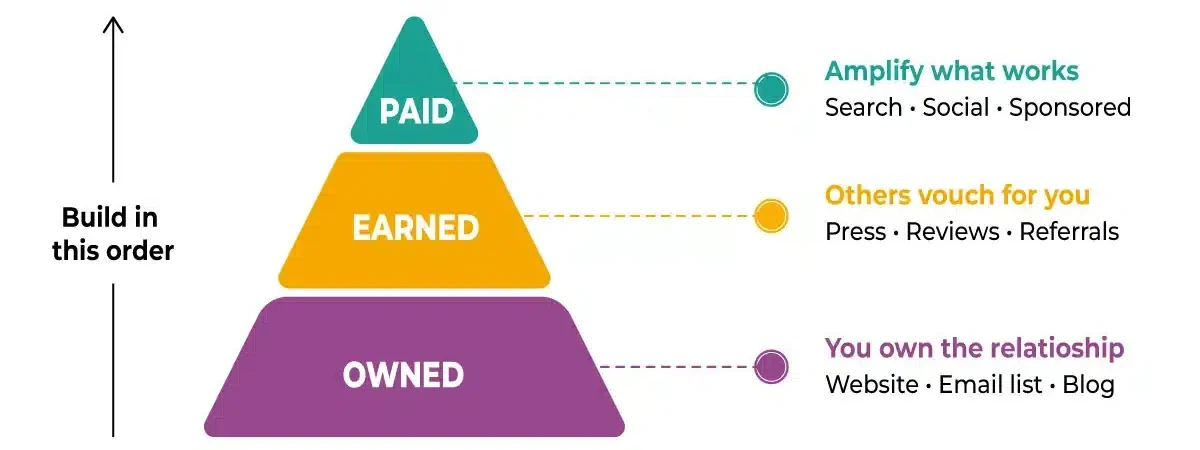
The order matters. Build your owned media foundation first. Earn credibility and referrals through the quality of your work. Use paid media to accelerate results once the first two are producing.
Building your content strategy
Content strategy is the engine of modern marketing. It’s how you get found, build trust, and stay in front of your audience between sales conversations.
A content strategy for a small business doesn’t require a large team or a complex editorial calendar. It requires clarity on four things.
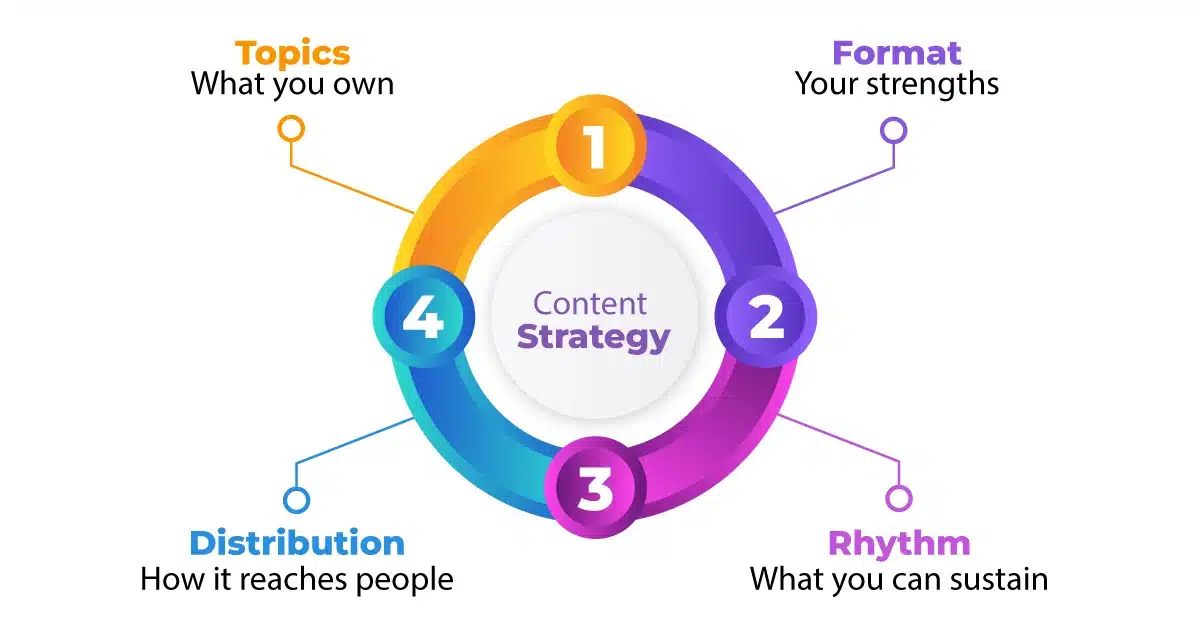
What topics do you own? These are the two or three areas where you have genuine expertise and where your ideal customer has real questions. Every piece of content you create should connect to these topics. If it doesn’t, it probably doesn’t need to exist.
What format fits your strengths? Some businesses write well. Others do better on video or in conversation. The best content strategy is one that produces content you can actually create consistently, not one that requires capabilities you don’t have. A business that commits to one blog post per week will always outperform a business that plans a podcast, a YouTube channel, and a newsletter but executes none of them reliably.
What’s the publishing rhythm you can sustain? One high-quality piece of content per week, published consistently for a year, will outperform five mediocre pieces per week published for two months. Commit to a rhythm that doesn’t require heroic effort. Then protect that rhythm like any other business commitment.
What’s the distribution plan? A blog post that sits on your website with no promotion is a tree falling in an empty forest. Every piece of content needs a plan for how it reaches your audience. Email, social media, internal linking, outreach to relevant publications. Distribution is as important as creation. Most businesses spend ninety percent of their time creating and ten percent distributing, when the ratio should be closer to equal.
Multilingual marketing
For businesses serving markets where English is not the primary language of all their customers, multilingual marketing is not optional. It’s a growth channel that most competitors are ignoring.
The US Hispanic market represents over 65 million people with significant purchasing power across nearly every industry. Spanish-speaking consumers search for products and services in Spanish, evaluate brands in Spanish, and make purchase decisions based on whether they feel that a brand actually understands them. A business that shows up authentically in Spanish is not just reaching a new audience. It’s reaching an audience that most of its competitors have left unserved.
A multilingual marketing strategy is not a translation project. It’s a commitment to showing up for a specific audience in the way they prefer to receive information. That requires content written in Spanish from the start, not translated from English. It requires understanding which platforms your specific Hispanic audience uses most. It requires cultural awareness that goes beyond language, including knowing which community you’re primarily speaking to, what register and tone that community uses, and what references and values resonate with them specifically.
The businesses that invest in multilingual marketing early build competitive advantages that are difficult to replicate later because trust with a community is not something you can buy. It has to be earned over time through consistent presence, genuine engagement, and content that was clearly made for them rather than adapted from something made for someone else.
Measuring what actually matters
A strategy without measurement is a guess. And guessing is the most expensive way to run a marketing program.
The measurement framework for a small business doesn’t need to be complex. It needs to answer three questions every month.
Those three numbers, tracked consistently, tell you whether your marketing is working and which channels deserve more investment. They also tell you when something isn’t working early enough to change course before you’ve spent significant resources on it.
Beyond those basics, the metrics worth tracking depend on your specific strategy. If you’re investing in SEO, watch organic traffic and keyword rankings in Google Search Console. If you’re running paid ads, watch cost per lead and cost per acquisition. If you’re building an email list, watch click-through rates, not just open rates. Click rates tell you whether your content is compelling enough to act on. Open rates only tell you whether your subject line worked.
The goal of measurement is not to produce reports. It’s to make better decisions about where to put your next marketing dollar.
Common strategy mistakes
Confusing tactics with strategy. Running Instagram ads is a tactic. Deciding to use paid social to generate leads from a specific audience segment, with a specific offer, tracked against a specific cost per lead target, is strategy. One of those has a chance of working. The other is activity.
Changing course too quickly. Most marketing channels take three to six months to produce meaningful results when done consistently. Businesses that evaluate a new channel after thirty days and move on are not being agile. They’re being impatient. Impatience is expensive.
Targeting everyone. A marketing strategy that tries to reach everyone in a market ends up resonating with no one specifically. The narrower your initial target, the stronger your message, and the more efficiently your budget works.
Ignoring the customer you already have. New customer acquisition gets most of the attention. Retention and expansion of existing customers generates most of the profit. A marketing strategy that focuses entirely on acquisition while neglecting the customers who already trust you is leaving significant revenue on the table.
Outsourcing strategy along with execution. You can and should bring in outside help for executional work. But the strategic decisions about who you’re trying to reach, what you’re offering, and why it matters have to be made by someone who deeply understands your business. That understanding can’t be fully outsourced.
Frequently asked questions
Where to go from here
Marketing strategy is not complicated. It’s clear thinking followed by disciplined execution followed by honest measurement.
Start with who you’re trying to reach. Get specific about what you’re saying and why it matters to them. Choose the one or two channels where you can show up consistently. Build the owned media foundation that gives you long-term control over your audience. Measure what matters. Adjust based on what the data tells you.
Do that consistently for six months and your marketing will outperform most of your competitors. Not because you did more. Because you did the right things in the right order with the right level of commitment.
Good strategy is not about having all the answers. It’s about asking the right questions and being honest enough to act on what you find.

Zoe Benway
Account Manager & Digital Strategist
Zoe is a digital strategist with 5+ years of experience helping small businesses grow through website strategy and digital marketing. She manages WordPress and Shopify sites and runs Google, Local Services, and Meta ad campaigns, with a hands-on approach that covers everything from building and optimizing websites to improving performance and troubleshooting client issues.
SHARE
Zoe Benway
Account Manager & Digital Strategist
Zoe is a digital strategist with 5+ years of experience helping small businesses grow through website strategy and digital marketing. She manages WordPress and Shopify sites and runs Google, Local Services, and Meta ad campaigns, with a hands-on approach that covers everything from building and optimizing websites to improving performance and troubleshooting client issues.
RELATED ARTICLES