Share this article

A brand is not a logo. It’s not a color palette or a tagline. A brand is what people think of when they hear your name, and what they tell others when they recommend you.
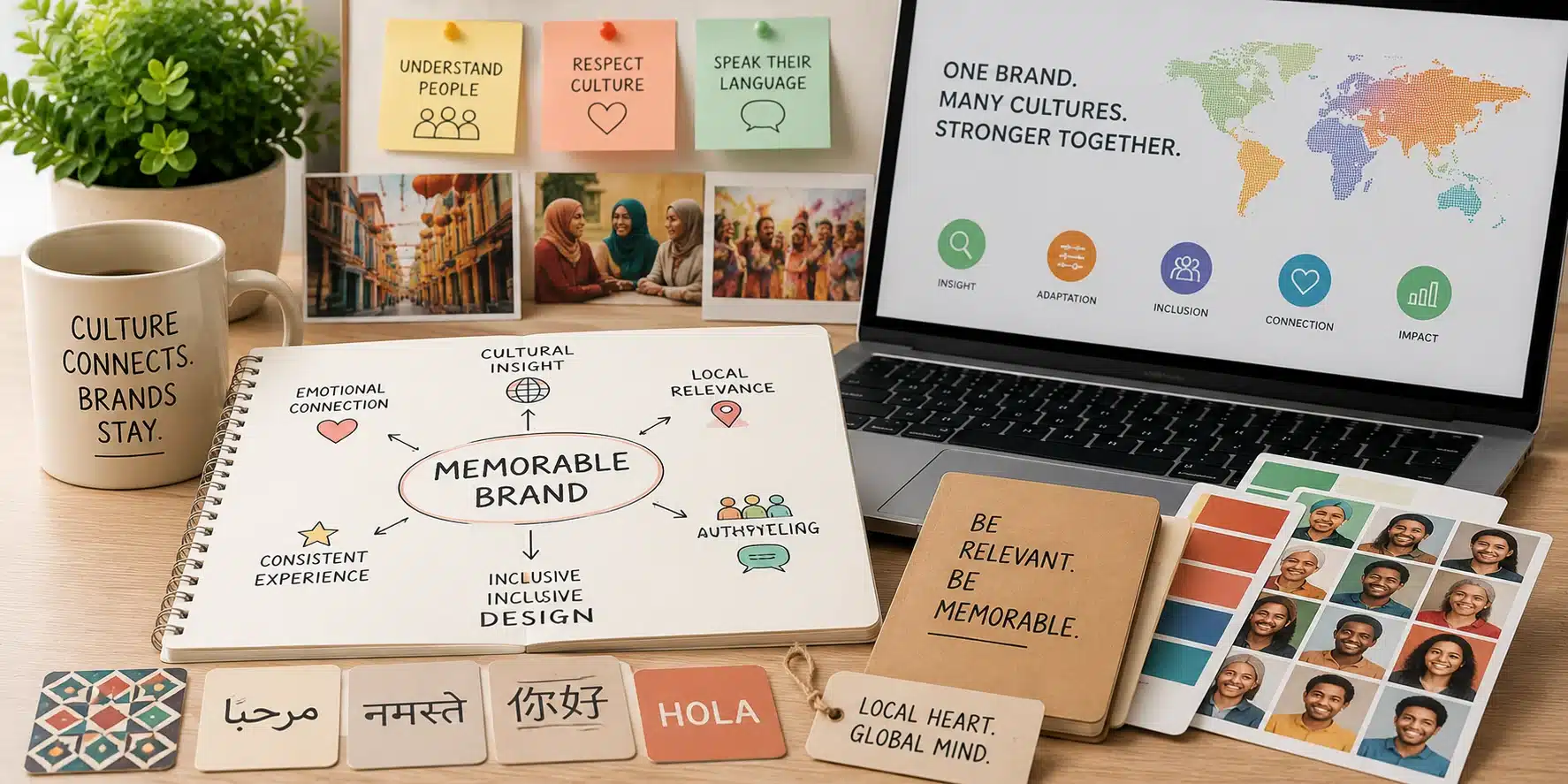
For businesses serving multicultural audiences, brand identity is more complex and more important than most marketing advice acknowledges. You’re not building one impression. You’re building trust across communities that have different references, different values, and different ways of deciding whether a brand is for them.

Why multicultural branding is different
Most branding advice is written with a single, monolithic audience in mind. Define your tone of voice. Pick your brand colors. Write your mission statement. Done.
That framework breaks down when your audience spans cultures. The tone that feels warm and approachable to one community can feel distant or overly formal to another. The imagery that resonates with one demographic can feel invisible or irrelevant to another. The values you emphasize in English may need to be expressed completely differently in Spanish to land the same way.
This doesn’t mean you need two brands. It means your brand needs to be built on something deep enough to translate across cultures without losing its meaning.
A brand that tries to be everything to everyone ends up meaning nothing to anyone. The goal in a multicultural market is not to appeal to all cultures equally. It’s to be authentically relevant to the specific communities you serve.
Start with values, not aesthetics
The businesses that build memorable brands in multicultural markets almost always start in the same place: with a clear articulation of what they actually stand for.
Values are more portable across cultures than visuals or language. A brand built around genuine expertise, transparency, community investment, or a specific commitment to its customers can translate across languages and demographics in a way that a specific color scheme or tone of voice cannot.
Before you decide how your brand looks or sounds in any language, answer these questions. What do you believe about the people you serve? What do you refuse to compromise on? What would you still stand for if no one was watching? Those answers are your brand foundation. Everything else is expression.
Voice and tone across languages
One of the most common and most damaging mistakes in multicultural branding is treating translation as a branding decision.
Translation is linguistic. Branding is cultural. When you translate your English brand voice into Spanish, you get Spanish words. You don’t get a Spanish-language brand voice. Those are different things.
A brand voice in Spanish needs to be built for Spanish, not derived from English. This includes the level of formality, the rhythm of the sentences, the kinds of humor or warmth that feel natural, and the cultural references that make the audience feel seen.
A financial services company that uses formal, distant language in English might need to use warmer, more conversational language in Spanish to achieve the same effect of trustworthiness with a Hispanic audience. A brand that’s confident and direct in English might need to be more relational and community-oriented in Spanish to avoid coming across as cold.
This is not about changing your values. It’s about expressing the same values in the way that actually lands.
Visual consistency across cultures
Visual identity needs to be consistent without being rigid. Your logo, your color palette, and your typography should be recognizable across all markets. That consistency is what builds recognition over time.
What should adapt is the imagery. The people in your photos, the settings, the situations you depict: these need to reflect the communities you’re serving. A healthcare brand that only shows one demographic in its imagery is communicating, without words, that it’s not for everyone else.
Real photography beats stock photography in multicultural markets more than almost anywhere else. Generic images of vaguely diverse groups in corporate settings communicate nothing. Specific images that reflect the actual lives of your audience build connection.
Visual and cultural consistency also requires a strategy behind it. If you’re building that from scratch, How to build a marketing plan with a limited budget is a practical place to start.
Cultural relevance without cultural appropriation
There’s an important line between brands that are culturally relevant and brands that are culturally opportunistic.
Cultural relevance means your brand understands the communities it serves, shows up for them consistently, and earns trust over time through genuine engagement. It means hiring people from those communities to create content for them. It means showing up year-round, not just during cultural moments. It means the people making decisions about how to reach those communities have real knowledge of and connection to them.
Cultural appropriation in branding looks like adopting the aesthetics or language of a community without the understanding, the relationships, or the sustained commitment. A brand that runs a Spanish-language campaign for Hispanic Heritage Month and then goes silent for the other eleven months of the year is not building a multicultural brand. It’s performing one.
The difference is visible to the communities in question, even when it’s invisible to the brand doing it.
Consistency is what makes a brand memorable
In a multicultural market, the brands that stick are the ones that show up consistently across every touchpoint: the website, the social media, the customer service experience, the sales conversation, the follow-up email.
When a Spanish-speaking customer calls and reaches someone who only speaks English, that’s a brand experience. When the Spanish content on a website is clearly machine-translated, that’s a brand experience. When a business posts in Spanish once a month and in English daily, that’s a brand experience.
Every inconsistency is a small signal that the brand isn’t really for you. Enough small signals add up to a brand that certain communities don’t trust, regardless of what the messaging says.
Memorable brands in multicultural markets are the ones that earned trust by showing up the same way every time, in every language, for every community they serve.
Brand consistency is just one piece of a larger marketing picture. If you’re ready to build a strategy that holds up across languages and communities, our guide to Marketing Strategy for Small and Mid-size Businesses walks you through the full framework.
We Want To Talk To You About Your Marketing Goals.
Let’s Supercharge Your Online Growth!
By submitting the form, you agree to the Terms of Service and Privacy Policy
We Want To Talk To You About Your Marketing Goals.
Let’s Supercharge Your Online Growth!