Resources The Complete Guide to Hispanic Marketing in the US
The Complete Guide to Hispanic Marketing in the US
There are over 62 million Hispanic people living in the United States. They represent $3.4 trillion in buying power. They are the fastest-growing consumer segment in the country. And most brands are still treating them as an afterthought.
Not because they don’t care. But because they think the solution is a Spanish translation of their existing content. It’s not.
This guide breaks down what Hispanic marketing actually is, why it works differently from general market marketing, and how to build a strategy that connects with Hispanic audiences for real.

What is Hispanic marketing
Hispanic marketing is the practice of reaching Hispanic consumers in a way that’s culturally relevant, not just linguistically accurate. That distinction matters more than most brands realize.
When a company translates its English website into Spanish using a generic tool, it communicates something to Hispanic consumers: you’re an afterthought. The words might be correct, but the tone, the references, the imagery, none of it was built for them.
Hispanic consumers notice. And they remember. The brands that actually win with this audience aren’t the ones with the biggest budgets. They’re the ones that took the time to understand who they’re talking to.
The difference between a brand that connects with Hispanic consumers and one that doesn’t usually comes down to one thing: whether they treated this audience as a translation problem or a cultural opportunity. Translation is a tool. Culture is the strategy.
What makes Hispanic marketing different from general multicultural marketing is specificity. Hispanic consumers in the US are not a monolithic group with shared preferences and behaviors. They’re a diverse, dynamic community shaped by immigration, acculturation, generational change, and the particular experience of living between two cultures. Effective Hispanic marketing starts with understanding that complexity, not simplifying it away.
The brands that get this right build something more valuable than market share. They build loyalty. And loyalty in the Hispanic market, once earned, tends to run deep.
Understanding the Hispanic market in the US
Before building a strategy, you need to understand who you’re actually trying to reach, because the Hispanic market is not one thing.
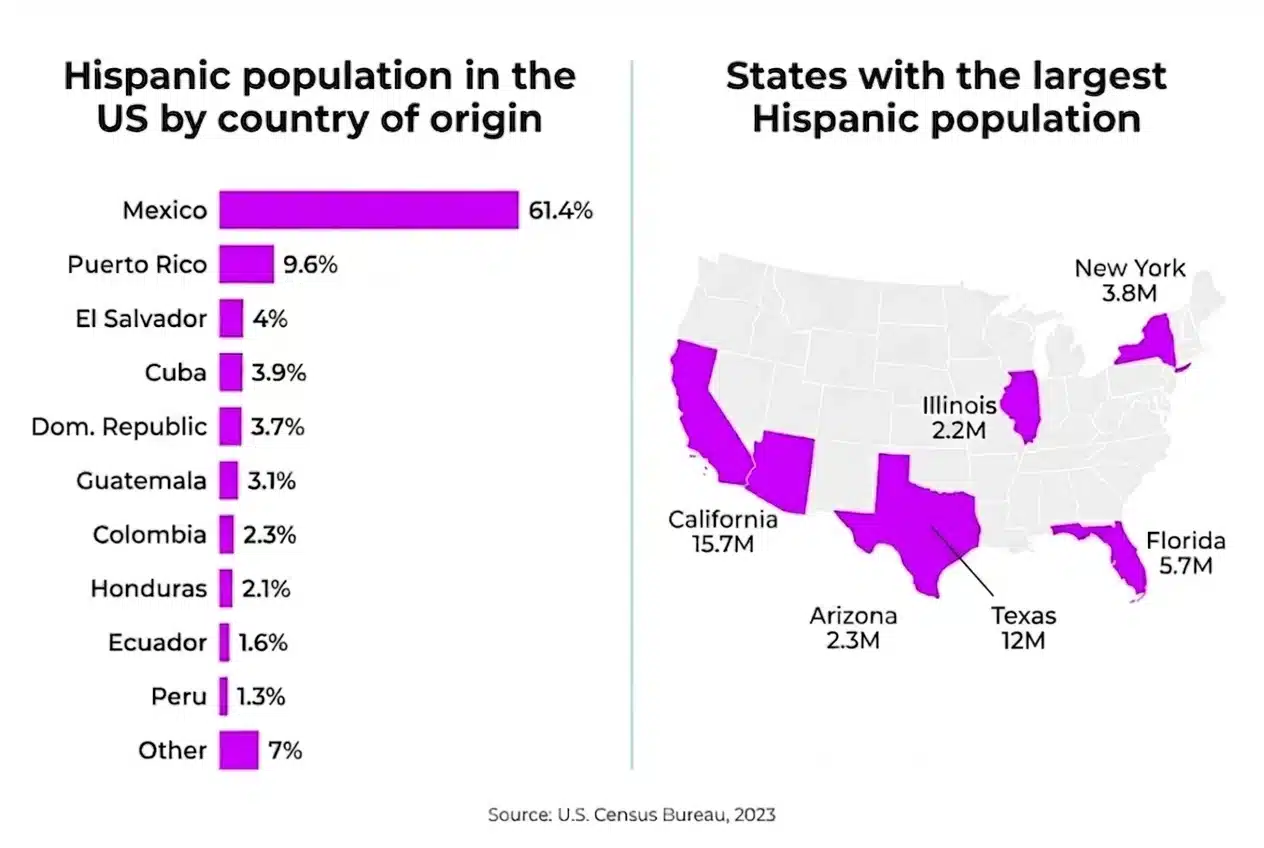
Hispanic Americans come from more than 20 countries of origin. A Cuban American in Miami, a Mexican American in Texas, and a Venezuelan in New York share a language, but their cultural references, their values, their relationship with the US, and even the Spanish they speak can be very different.
Then there’s the question of acculturation. Some Hispanic consumers are recent immigrants who primarily speak Spanish and navigate the world through that lens. Others are second or third generation, fully bilingual, equally comfortable in English and Spanish. Some prefer English entirely, but still identify strongly with their Hispanic heritage.
This means your strategy can’t be one-size-fits-all. The first question isn’t “should we do Spanish content?” It’s “who specifically are we trying to reach, and how do they actually live?”
A few things that hold true across most segments: family and community are central values. Trust is earned slowly and lost quickly. And authenticity matters more than polish.
The numbers behind this market are significant. Hispanic consumers represent the fastest-growing demographic in the US, projected to make up nearly 30 percent of the total population by 2060. Their buying power is growing faster than any other demographic segment. They skew younger than the general population, which means the brands that build relationships with Hispanic consumers now are building relationships that will compound for decades.
This is not a niche market. It’s a mainstream market with cultural depth, and it rewards brands that treat it that way. The brands entering this space now, while it’s still underserved relative to its size, have a real opportunity to build lasting competitive advantage.
The 4 pillars of effective Hispanic marketing
Most brands focus only on language. The brands that actually win with Hispanic audiences understand that language is just the starting point.
Language
The question isn’t just Spanish or English. It’s about understanding when each one, or both, makes sense for your specific audience.
Bilingual content often performs well with second-generation consumers who move fluidly between both languages. Spanish-first content works better when targeting recent immigrants or older demographics. And for some highly acculturated consumers, English-first content with cultural cues is the right call.
There’s no universal answer. But there is a wrong one: using Spanish only when it’s convenient for your campaign calendar. If your brand shows up in Spanish in October and goes silent the rest of the year, Hispanic consumers notice. And they remember.
Culture
This is where most brands underinvest. Culture isn’t a visual filter you apply at the end of a campaign. It’s the foundation of the message itself.
What does family mean in this context? How does this community think about success, loyalty, health, money? What does it feel like to navigate the US as a Hispanic person? These aren’t abstract questions. They shape what resonates and what falls flat.
A good example: a financial services brand running ads about “building your future” will land very differently with a first-generation immigrant focused on sending remittances home than with a third-generation professional planning for retirement. Same English words. Completely different lives. Cultural marketing is about understanding that gap and building your message around it.
It’s not about stereotypes or broad strokes. It’s about specificity. The more specific and honest you are, the more it lands.
Platforms
Hispanic consumers are active on the same platforms as everyone else, but the patterns are different and they matter.
Facebook and Instagram remain strong across age groups. YouTube is especially powerful for Spanish-language content, with some of the most-watched channels in the US being entirely in Spanish. WhatsApp is how many Hispanic families communicate daily, which means word-of-mouth and community recommendations travel through channels that most brands aren’t even thinking about.
TikTok has a massive and growing Hispanic creator community. If your audience skews younger, that’s not just worth considering, it’s worth prioritizing. And don’t overlook the value of partnering with Hispanic creators who already have the trust of their audience. That trust transfers.
Trust
This one is non-negotiable, and it’s the hardest one to shortcut.
Hispanic consumers tend to be highly loyal to brands they trust, and deeply skeptical of brands that feel opportunistic. The difference between the two often comes down to consistency and sincerity.
Showing up only during Hispanic Heritage Month doesn’t build trust. It erodes it. The community has seen it enough times to recognize it immediately.
What builds trust is consistent presence. Engaging with comments in Spanish when someone leaves one. Featuring Hispanic employees and stories year-round, not just in October. Partnering with community organizations not because it’s a PR moment but because it makes sense. These things add up over time in ways that no single campaign can replicate.
Translation vs transcreation: why it matters
Translation converts words from one language to another. Transcreation converts meaning.
A tagline that works in English because it plays on a cultural reference, a pun, or a specific emotional tone might land completely flat in Spanish. Or worse, it might mean something different than you intended.
Transcreation takes that original intent and rebuilds it in the target language and culture from the ground up. The words might be completely different. The result is a message that feels like it was written for that audience, because in a way, it was.
For most marketing content, you need transcreation, not translation. The exception is purely informational content where the goal is just to communicate information clearly, think legal disclaimers, product specs, or FAQs. For anything that needs to persuade, inspire, or connect emotionally, transcreation is the standard.
Common mistakes
Most brands that want to reach Hispanic consumers are trying in good faith. But somewhere between the strategy meeting and the actual execution, the same mistakes keep showing up.
The most common ones: relying on Google Translate for marketing copy, treating all Hispanic consumers as one homogeneous group, only showing up during Hispanic Heritage Month, ignoring Spanish-language SEO entirely, and featuring Hispanic faces in ads without adapting the message culturally.
Each of these mistakes has the same underlying cost: lost trust with an audience that values authenticity above almost everything else.
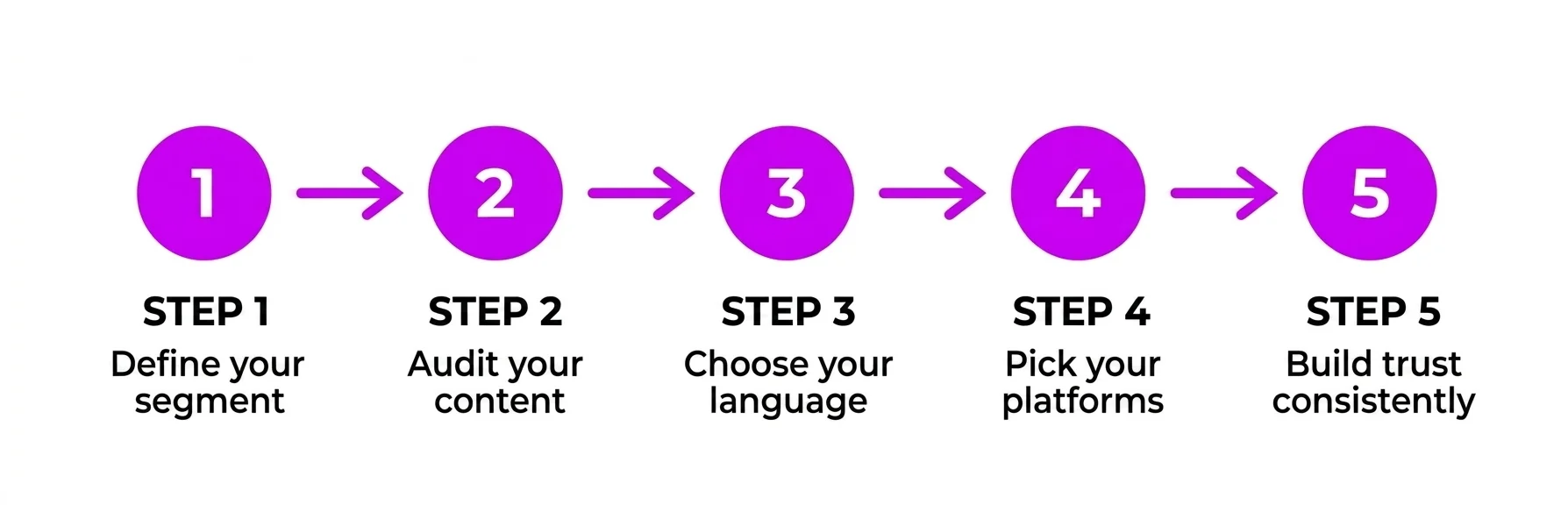
Building your strategy
Step 1: Define your segment specifically
Don’t start with “Hispanic Americans.” That’s 62 million people across dozens of countries of origin. Start with something specific, like bilingual Mexican American women, 28 to 45, living in Texas, interested in health and wellness. Starting specific gives you a real audience to build for instead of a demographic category to market at.
Step 2: Audit what you already have
Before creating anything new, look at your existing content with fresh eyes. Is it translatable or does it require transcreation? Does your imagery reflect your audience? This audit often reveals that the issue isn’t a lack of content. It’s content that wasn’t built with this audience in mind.
Step 3: Choose your language approach
Based on who you’re reaching and where they are in the acculturation spectrum, decide whether you’re going Spanish-first, bilingual, or English with cultural adaptation. Then commit to it consistently across channels. The mistake most brands make is being inconsistent. Spanish on Instagram, English on the website, nothing on email. That patchwork approach confuses consumers and signals that the strategy isn’t fully thought through.
Step 4: Pick one or two platforms and do them well
Don’t try to be everywhere at once. Look at where your specific audience actually spends time, pick the one or two platforms that make the most sense, and show up there with intention and consistency. It’s always better to do two platforms well than five platforms poorly. Starting focused also makes it easier to learn what works before you scale.
Step 5: Build trust through consistency
Set a realistic publishing cadence and stick to it. Engage with comments and messages, especially in Spanish when someone reaches out in Spanish. Partner with Hispanic creators or community organizations when it makes sense for your brand. Show up the same way every month, not just in October. Trust is built in small moments over a long time. There’s no shortcut, but there is a clear path: show up, be consistent, and treat the community like they matter year-round.
One more thing worth saying: this strategy doesn’t require a massive budget. It requires commitment and consistency. Some of the most effective Hispanic marketing comes from brands that show up authentically with modest resources, not from brands that spend heavily without cultural understanding.
Frequently asked questions
Where to go from here
Hispanic marketing done right isn’t a campaign. It’s a commitment to showing up consistently, authentically, and with real cultural understanding.
Language gets attention. Culture drives conversion.
If you’re ready to build a strategy that actually connects with Hispanic audiences, MoDuet can help. We’re a boutique trilingual digital marketing agency based in Louisville, KY. We help businesses connect with English, Spanish, and French-speaking audiences through marketing that’s culturally intelligent, not just translated.

Patricia Franco
Account Manager & Digital Strategist
Patricia is a digital strategist with 8+ years of experience helping startups and growing businesses maximize their marketing budgets through data-driven strategies. She specializes in SEO, website optimization, and performance-focused digital marketing. Bilingual EN/ES.
SHARE
ON THIS PAGE
Patricia Franco
Account Manager & Digital Strategist
Patricia is a digital strategist with 8+ years of experience helping startups and growing businesses maximize their marketing budgets through data-driven strategies. She specializes in SEO, website optimization, and performance-focused digital marketing. Bilingual EN/ES.
RELATED ARTICLES