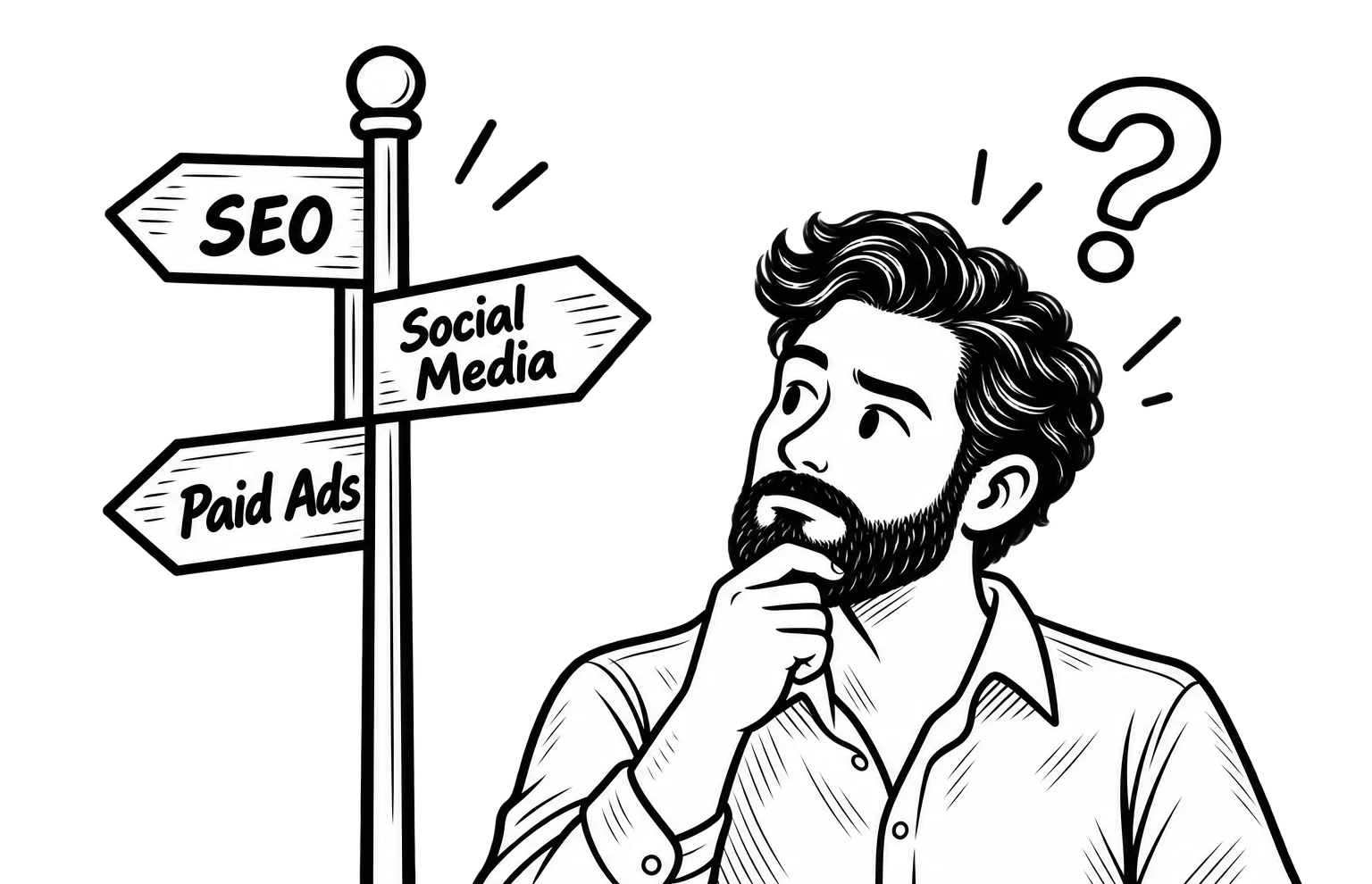
When to hire a marketing agency vs do it yourself
When to hire a marketing agency vs do it yourself
Not sure whether to hire a marketing agency or keep marketing in-house? Learn the signs you've outgrown DIY marketing, what to look for in an agency, and when a hybrid approach makes sense.


At some point, every business owner hits a ceiling with DIY marketing. The question is whether they recognize it when it happens or spend another year pushing through it.
There’s no shame in doing your own marketing when you’re starting out. Most businesses have to. The problem is that the skills and capacity required to market effectively grow as the business grows. Eventually, the gap between what you can do and what your business needs can become a liability.
The decision to hire a marketing agency comes down to three things: your results, your available time, and the expertise your business needs to grow.
Hiring an agency isn’t automatically the right next step. Neither is continuing to do everything yourself.
Here’s how to figure out where you are and which approach makes the most sense for your business.
When DIY Marketing Makes Sense
DIY marketing works when you have more time than money, a clear message, and a limited number of channels to maintain.
In the early stages of a business, the founder often knows the customer better than anyone else. That knowledge produces authentic content, genuine engagement, and a clear voice that an outside agency needs time to understand.
There are good reasons to keep marketing in-house when you’re starting out.
You have direct access to customer questions, understand what makes your business different, and can respond quickly without coordinating with another team.
You may also be working with a budget that makes professional marketing support difficult to justify.
Signs DIY Marketing Is Still Working
Doing your own marketing may be the right choice if:
- You’re consistently maintaining one or two relevant channels.
- Your marketing is generating inquiries or sales.
- You understand which activities produce results.
- You have enough time to plan and execute effectively.
- Marketing isn’t interfering with other important business responsibilities.
If you’re generating leads, converting customers, and the process isn’t consuming you, there’s no urgent case for hiring outside help.
The system is working.
The mistake isn’t doing your own marketing. It’s continuing with the same approach after your business has outgrown it.
Five Signs You’ve Reached the DIY Marketing Ceiling
The DIY ceiling doesn’t always announce itself clearly.
It usually appears as a gradual drain on time, inconsistent execution, or results that stop improving despite continued effort.
1. You’re Busy Marketing, but the Business Isn’t Growing
You’re posting on social media, sending emails, running advertisements, and updating your website.
There’s plenty of activity, but revenue has plateaued.
That doesn’t necessarily mean you need to produce more content or increase your advertising budget.
It may mean your strategy needs to change.
When you’re responsible for executing every marketing task, finding time to evaluate the bigger picture becomes difficult.
You can end up spending all your time doing marketing without examining whether it’s moving the business forward.
2. Marketing Is Taking Time Away From Running the Business
Every hour you spend on marketing is an hour you can’t spend elsewhere.
That may be perfectly reasonable when the marketing generates enough value.
But if writing captions, managing campaigns, or updating your website consistently takes time away from clients, operations, or business development, you need to consider the opportunity cost.
For example, if your time could be spent on higher-value client work, doing a specialized marketing task yourself may be more expensive than outsourcing it.
The relevant cost isn’t just what an agency charges. It’s also what your business gives up when you’re doing the work.
3. You Don’t Know What’s Actually Working
If you can’t identify which marketing channels are generating your best customers, you have a measurement problem.
You might know how many people visited your website or liked your posts.
But can you connect those activities to qualified leads, sales, or revenue?
If not, increasing your budget is largely guesswork.
Our guide on how to measure marketing ROI without being a data expert explains the basic numbers business owners should track.
Before investing in outside help, it’s worth understanding what you can already measure and where the gaps are.
4. You’ve Tried Different Tactics Without Understanding Why They Failed
Maybe you ran Google Ads that generated clicks but no leads.
Or you hired someone to create social content that didn’t sound like your business.
Perhaps you’ve invested in SEO but don’t understand why your website isn’t attracting the right visitors.
A disappointing campaign doesn’t automatically mean the marketing channel doesn’t work.
The problem could involve targeting, positioning, the offer, your website, or the way results are being measured.
Without someone who can diagnose the problem, it’s easy to keep testing different tactics without learning much from the results.
5. You’re Preparing for Significant Growth
Expanding into a new market, launching a major product, or targeting a different audience creates additional marketing demands.
The strategy that worked when your business was smaller may not support the next stage.
You may need specialized expertise, more consistent execution, or better coordination between your website, advertising, content, and sales processes.
That doesn’t mean you need to outsource everything.
It means evaluating whether your current team has the time and capabilities required for what comes next.

What Does a Good Marketing Agency Actually Do?
The word “agency” covers a wide range of services and approaches.
Some agencies specialize in advertising. Others focus on SEO, branding, web development, or social media. Some provide broader strategic support.
Understanding what you’re actually buying helps you make a better decision.
A good marketing agency should do more than complete a list of tasks.
It should help you understand your audience, identify opportunities, establish priorities, and evaluate results.
The execution, including content, advertising, SEO, and website improvements, should follow that strategy.
If you’re hiring an agency purely for execution without strategic alignment, you’ll get activity without direction.
That’s not necessarily better than DIY. It’s just more expensive.
Strategy vs. Execution: Know What You Need
Before hiring an agency, determine whether your biggest problem is planning or capacity.
If you know exactly what needs to be done but don’t have time to execute it, you may need specialized support.
If you’re unsure which channels deserve investment, why campaigns aren’t converting, or how marketing should support your business goals, strategic guidance may be more valuable.
Many businesses need a combination.
But paying for a comprehensive agency relationship when you only need help with one clearly defined task may not be the best use of your budget.
How Much Should You Spend on a Marketing Agency?
There isn’t one marketing agency budget that makes sense for every business.
The appropriate investment depends on your goals, the scope of work, your current resources, and the potential business value.
Start by asking what problem you’re paying the agency to solve.
Are you trying to increase qualified leads, improve customer retention, launch a product, or build a more reliable marketing operation?
Then consider the economics.
If you spend $1,500 per month on marketing support, what improvement would make that investment worthwhile?
The answer depends on your profit margins, customer acquisition costs, and customer value.
For a business with high-value contracts, a small number of additional customers might justify the investment.
For a business selling low-margin products, the same investment may require a much larger increase in sales.
Understand What the Fee Includes
Before signing an agreement, clarify whether the proposed cost covers:
- Marketing strategy and planning.
- Content creation and design.
- Campaign setup and management.
- Advertising spend.
- Website updates or landing pages.
- Analytics, reporting, and optimization.
- Meetings and account management.
Agency fees and advertising budgets are often separate expenses.
Also ask whether the agreement includes a minimum commitment and what happens if the scope of work changes.
A lower monthly fee isn’t necessarily a better deal if it excludes the work your business actually needs.
What to Look for Before Hiring a Marketing Agency
Choosing an agency shouldn’t begin with a presentation full of impressive promises.
It should begin with a conversation about your business.
They Ask Questions Before Offering Solutions
An agency that recommends a complete marketing package before understanding your customers, goals, budget, and challenges is giving you important information about its approach.
The first conversation should involve more listening than selling.
They Can Explain Relevant Experience
Ask for examples of work involving businesses with comparable goals or challenges.
A useful case study explains the problem, the approach, and the outcome.
Impressive numbers without context don’t tell you much.
A campaign that generated thousands of clicks may have been successful, but only if those clicks supported the business objective.
They’re Honest About Their Capabilities
No agency is equally strong at everything.
A reliable partner should be able to explain what it does well, where it may need additional specialists, and which requests fall outside its expertise.
Be cautious of anyone promising guaranteed rankings, instant growth, or results without first understanding the business.
They Discuss Measurement From the Beginning
Ask how success will be measured.
What metrics will be tracked? How frequently will performance be reviewed? Who will have access to advertising accounts and analytics?
A good agency should be able to explain how its work will be evaluated and what decisions will follow from those results.
They Understand Your Long-Term Goals
Your agency should know where you want the business to go, not just what you want published next month.
That broader perspective helps prevent disconnected campaigns and investments that don’t support your priorities.
DIY vs. Agency vs. Hybrid: Which Approach Fits Your Business?
For many small businesses, the decision isn’t strictly between doing everything internally and outsourcing everything.
There are three practical approaches.
| Approach | Best Fit | Main Consideration |
|---|---|---|
| DIY marketing | Early-stage businesses with limited budgets and available time | Requires consistent attention and ongoing learning |
| Marketing agency | Businesses needing specialized expertise, strategic direction, or broader execution | Requires budget, collaboration, and clear expectations |
| Hybrid approach | Businesses that want to retain some responsibilities while outsourcing others | Requires coordination and a shared strategy |
The Hybrid Approach
A hybrid model allows you to keep the work that makes sense internally while bringing in expertise where it’s needed.
You might manage your own social media because you’re closely connected to your customers, while an agency handles technical SEO and your website.
Or you might create your own content while working with a specialist on paid advertising.
The division of responsibilities should follow your capabilities and capacity, not a fixed formula.
The important part is having a shared strategy.
Without one, your internal team and outside partners can end up working toward different objectives.
How to Know Whether Hiring an Agency Is Paying Off
Hiring an agency doesn’t remove your responsibility to understand your marketing performance.
You shouldn’t need to manage every campaign detail, but you should know what you’re investing in and what the business is getting in return.
Start with the goals established before the engagement.
If the objective is lead generation, review the number and quality of inquiries, the cost to acquire them, and how many become customers.
If the goal is improving your website, examine relevant measures such as qualified traffic, conversion rates, and completed inquiries.
If you’re building brand awareness, use appropriate reach and recognition measures without treating them as proof of increased revenue.
Review Progress, Not Just Reports
A report should help you understand three things:
- What happened?
- Why does it matter?
- What should happen next?
If you’re receiving pages of metrics without useful conclusions or recommendations, ask for clearer reporting.
Also be realistic about timing.
Some changes can be evaluated quickly, while SEO, positioning, and longer-term content efforts may need more time before meaningful results emerge.
An agency shouldn’t promise immediate results from every activity, but it should be able to explain what progress looks like and how performance will be assessed.
When Should You Keep Marketing In-House?
There are situations where hiring an agency isn’t the best next step.
If your offer is still changing every week, your ideal customer isn’t clear, or your business lacks the capacity to handle more sales inquiries, outside marketing support may not solve the immediate problem.
You may need to strengthen your business fundamentals first.
Similarly, if your existing marketing consistently produces profitable results and you have the time and expertise to manage it, outsourcing may offer limited additional value.
An agency should solve a business problem, not simply add another monthly expense.
Make the Decision Based on What Your Business Needs Next
The question isn’t whether you could do your own marketing.
It’s whether DIY marketing is still the highest-value use of your time at this stage of your business.
For some owners, staying hands-on is the right decision. For others, professional support creates the capacity and expertise they need to move forward.
And for many businesses, the answer is somewhere in between.
Look at your current results, identify what’s limiting growth, and determine which responsibilities make sense to keep.
If you decide to bring in outside help, look for a partner who understands your business, explains its recommendations, and measures success against meaningful goals.
If you’re ready to explore what outside support could look like, MoDuet’s digital marketing services can help you evaluate your priorities and identify the right level of support.