Share this article

If you have ever Googled “how to improve my website ranking” and walked away more confused than when you started, you are not alone. SEO has a reputation for being complicated, and that reputation has given rise to a lot of myths. Some of these myths sound reasonable. A few of them were even true at some point. But in 2025, believing the wrong things about SEO is not just a waste of time. It can actively hurt your business.
Here are five of the most common SEO myths we hear from small business owners, and what the reality actually looks like.

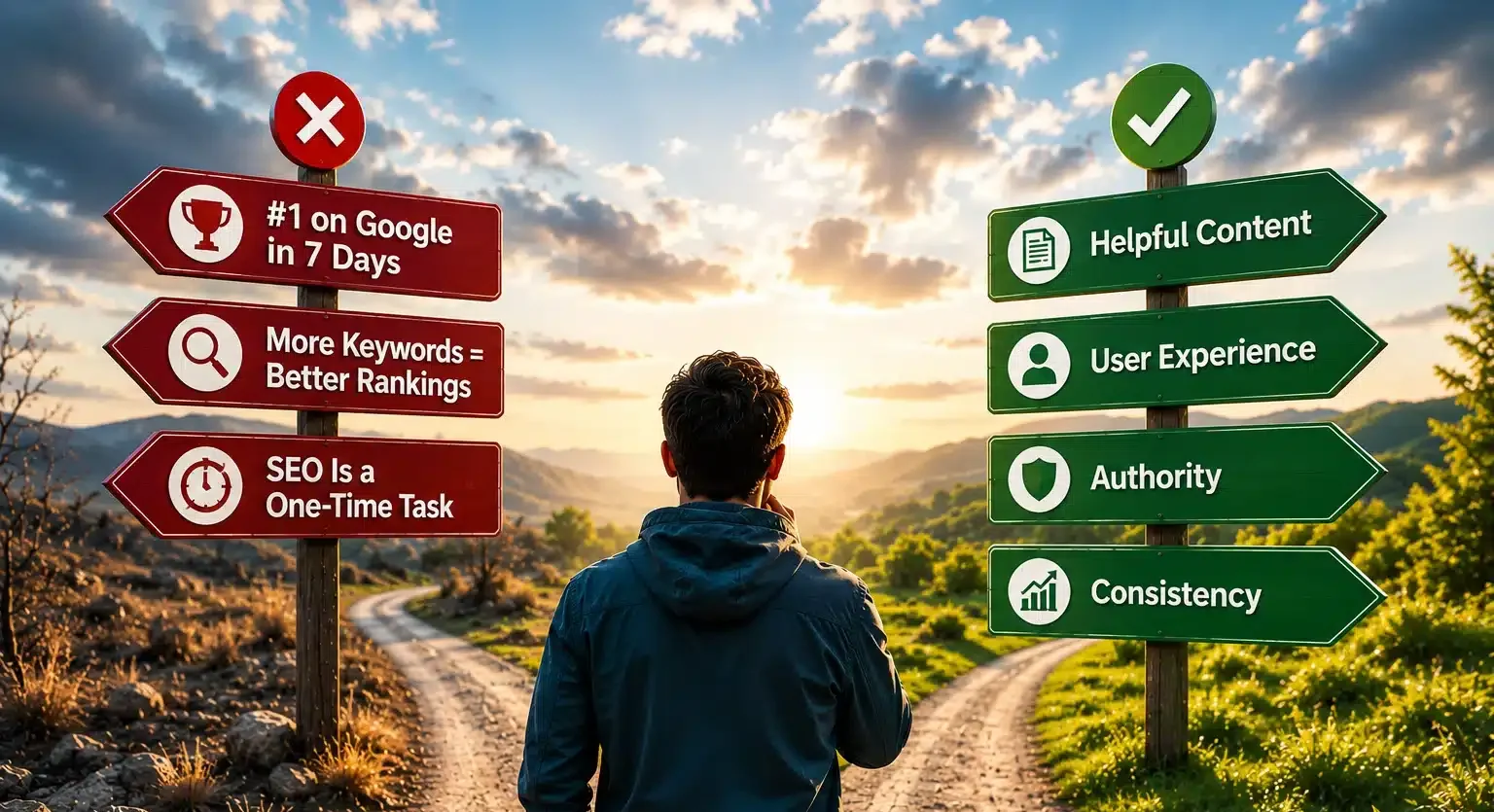
Myth 1: SEO Is a One-Time Thing
This is probably the most common misconception we come across. A business owner invests in SEO, their site climbs in rankings, and then they move on assuming the work is done. A few months later, they are wondering why their traffic dropped.
SEO is not a project with a finish line. Google updates its algorithm hundreds of times a year. Your competitors are publishing content, building links, and improving their sites constantly. The digital landscape shifts, and what worked six months ago may not be enough today.
Think of SEO like maintaining a garden. You can plant everything perfectly and longest see great results. But if you walk away and never water it, never pull the weeds, never tend to what is growing, things fall apart quickly. Ongoing SEO work, even at a maintenance level, is what keeps your rankings stable and growing over time.
Myth 2: More Keywords Means Better Rankings
There was a time when stuffing a page full of keywords was a legitimate strategy. That time ended around 2012. Today, Google is sophisticated enough to understand context, intent, and natural language. Overloading a page with keywords does not help your rankings. It hurts them.
More importantly, keyword stuffing makes for a terrible reading experience. When someone lands on your page and the copy feels robotic or unnatural, they leave. And when visitors leave quickly, Google notices that too.
What actually works is writing content that genuinely answers what your audience is searching for. Use your primary keyword where it makes sense, like in the title, the introduction, and a few natural spots throughout the page. Then focus the rest of your energy on being helpful and clear. Google rewards pages that people find useful and stay on.
Myth 3: A Brand New Website Will Rank Right Away
Launching a new website is exciting. And it is easy to assume that once it is live, it will start showing up in search results. But new sites almost always go through what SEO professionals call a “sandbox” period, where Google is essentially evaluating the site before it starts ranking it competitively.
For most businesses, it takes three to six months before organic traffic from SEO starts to become meaningful. That timeline can shorten if your site is well-built, has strong content, and earns quality backlinks early on. But there are no shortcuts past the trust-building phase.
This is why it is smart to start your SEO strategy before or right at launch, not as an afterthought. The structure of your site, the content on your pages, and your technical setup all send signals to Google from day one. Getting those foundations right from the start makes a real difference in how quickly you gain traction. If you are not sure where to start, ranking on Google without a big budget is a good place to begin.
Myth 4: Social Media Has No Effect on SEO
To be fair, there is a grain of truth here. Social media likes and shares are not direct ranking factors. Google has confirmed this. But saying social media has no effect on SEO misses the bigger picture.
When your content gets shared on social media, it reaches more people. More people means more chances that someone will link to your content from their website, their blog, or their newsletter. Those links are direct ranking signals. Social media is essentially an amplifier for the kind of exposure that does influence SEO.
There is also a brand awareness angle. People who see your business on Instagram or LinkedIn and then search for you on Google are sending behavioral signals that contribute to your overall search presence. SEO and social media are not competing strategies. They work better together.
Myth 5: SEO Is Only About Google Rankings
Rankings matter. But ranking number one for a keyword that no one is searching for, or that attracts the wrong kind of visitor, does not grow your business. This is a mistake a lot of small business owners make when they focus on rankings as the end goal.
The real goal of SEO is to attract the right people to your website and give them a good enough experience that they take action, whether that means calling you, filling out a form, or making a purchase. That means your content, your site speed, your mobile experience, and your messaging all play a role. Ranking without converting is just vanity traffic.
A well-rounded SEO strategy looks at keyword intent, site performance, user experience, and conversion together. Not just where you show up in search results, but what happens after someone clicks. And if you serve customers in more than one language, that adds another layer entirely. SEO in Spanish works differently than most businesses expect, and it is worth understanding before you assume your English strategy covers both.
One More Thing Worth Knowing: SEO Is Changing
Beyond Google rankings, there is a newer shift happening that most small business owners have not heard of yet. AI tools like ChatGPT, Perplexity, and Google’s AI Overviews are changing how people find information online. Showing up in those answers requires a slightly different approach. If you want to get ahead of that curve, our post on what GEO is and why it matters for your business in 2026 breaks it down in plain language.
What Good SEO Actually Looks Like
Good SEO is not about tricks or loopholes. It is about building a site that is fast, easy to use, and full of content that genuinely helps your audience. It takes time and consistency, but the results compound in a way that paid advertising simply cannot.
Whether you are trying to reach local customers or grow nationally, the strategy looks different depending on your goals. Our guide on local SEO vs national SEO can help you figure out which direction makes the most sense for your business.
For the full picture on how SEO works and what it takes to build lasting visibility, our complete guide to SEO for growing businesses covers the strategy from the ground up.
Not Sure Where Your SEO Stands?
We work with small businesses and growing brands to build SEO strategies that actually move the needle. If you want a clearer picture of how your site is performing and where the real opportunities are, we are happy to take a look. Reach out to the MoDuet team and let us know what you are working with.

We Want To Talk To You About Your Marketing Goals.
Let’s Supercharge Your Online Growth!
By submitting the form, you agree to the Terms of Service and Privacy Policy
We Want To Talk To You About Your Marketing Goals.
Let’s Supercharge Your Online Growth!