The Future of Content Marketing: AI, Search, and Human Expertise
The Future of Content Marketing: AI, Search, and Human Expertise
Content marketing is changing as AI makes production easier and discovery more fragmented. See why original expertise, smarter distribution, useful formats, and stronger measurement matter more than simply creating more content.


Content marketing is becoming easier to produce and harder to make valuable.
AI can create drafts in seconds. Search engines can answer questions without requiring a traditional click. Social platforms increasingly act as discovery engines. Creators influence how people evaluate products and companies. And audiences have more content competing for their attention than ever before.
That does not make content marketing less important.
It changes what good content needs to accomplish.
The future is not about publishing more simply because technology makes that possible. It is about creating information, ideas, and experiences that are useful enough to be discovered, trusted, remembered, and acted on.
AI Is Moving From Content Tool to Content Workflow
The first wave of generative AI in marketing focused heavily on writing.
Ask for a blog outline.
Generate social captions.
Rewrite an email.
Create five headline options.
Those capabilities are still useful, but AI is increasingly becoming part of the broader content workflow.
Teams can use it to support:
- Topic research
- Audience analysis
- Content briefs
- Drafting
- Editing
- Content repurposing
- Data analysis
- Content audits
- Personalization
- Performance reporting
That can reduce repetitive work and help smaller teams accomplish more.
But increased production capacity creates another problem.
If every company can produce ten articles where it previously produced two, simply creating more material is no longer much of an advantage.
Our guide to how AI is changing content writing looks more closely at where AI can accelerate the writing process and where human expertise still needs to lead.
AI can make content production faster, but speed is no longer the advantage.
When everyone can create more, original expertise, judgment, and useful ideas become more valuable.
Generic Content Is Becoming Easier to Ignore
For years, much of content marketing followed a familiar formula.
Find a keyword.
Look at the pages ranking for it.
Create a similar article.
Make yours slightly longer.
Add a few more headings.
Publish.
AI makes that approach dramatically easier to scale.
It also makes the result easier to replace.
If an article simply summarizes information that already exists across dozens of websites, there is increasingly little reason for someone, or an AI system, to prefer that specific page.
Google’s current guidance for generative search emphasizes valuable, non-commodity content: information that contributes unique experience, expertise, perspective, or usefulness rather than simply repeating what is already available.
For businesses, that creates an opportunity.
The information competitors cannot easily reproduce becomes more important.
That might include:
- Experience from actual client work
- Original research
- Proprietary data
- Customer questions
- Case studies
- Internal processes
- Expert commentary
- Industry observations
- Product testing
- Lessons learned
- Strong points of view
The goal is not to be different simply for the sake of being different.
It is to contribute something.
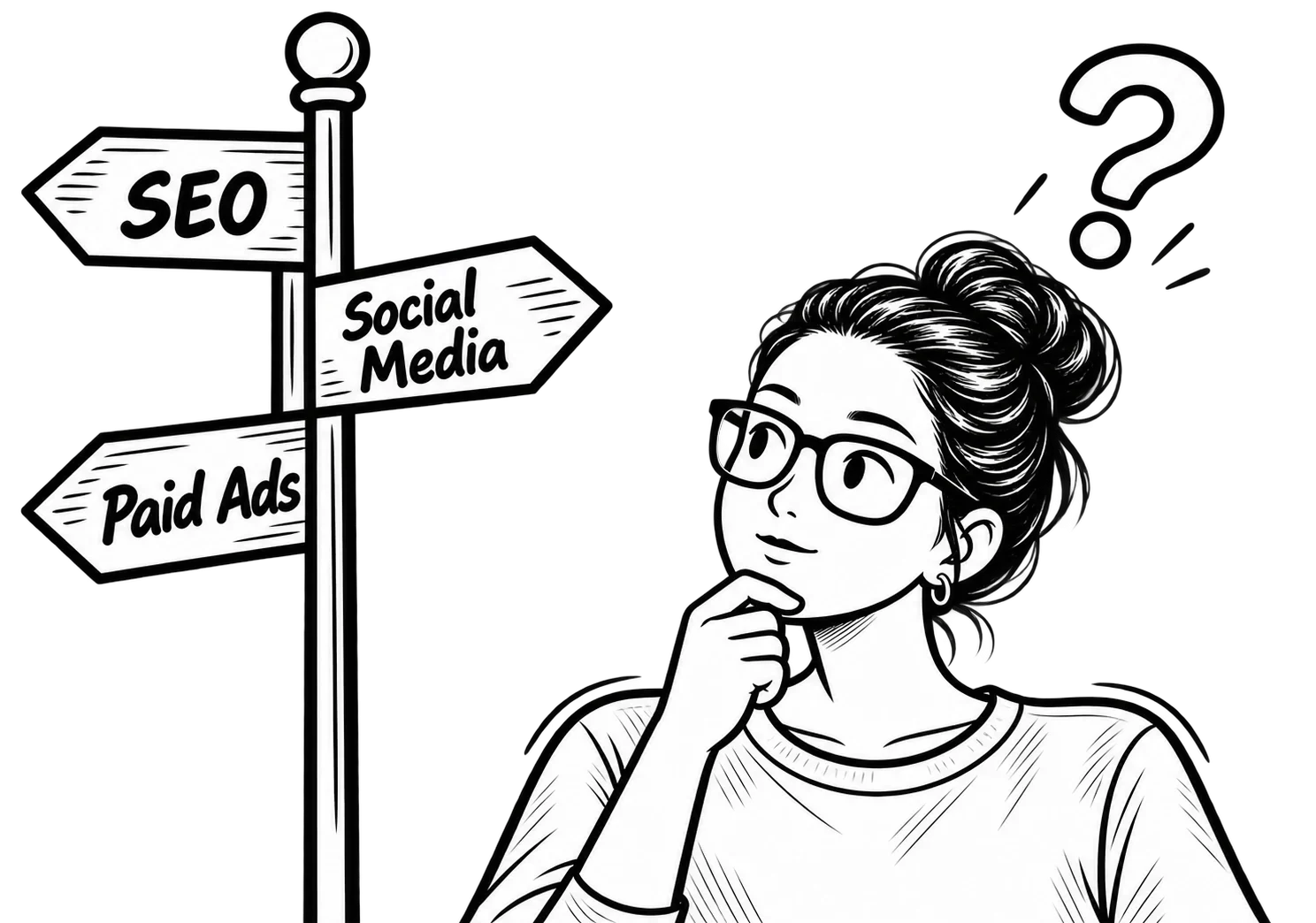
Search Is Becoming One Discovery Channel Among Many
Traditional Google results remain important.
But people now discover information through a much broader collection of experiences.
They may:
- Search Google
- Read an AI Overview
- Ask an AI assistant
- Search TikTok
- Watch YouTube
- Look through Reddit discussions
- Ask a professional community
- Find a creator on LinkedIn
- Follow a recommendation from an email
- Discover a product through social content
That means content strategy can no longer assume that publishing a blog post and waiting for Google traffic completes the job.
Google itself now treats AI Overviews and AI Mode as extensions of Search and says its existing SEO fundamentals remain important for appearing within those generative experiences.
Our guide to SEO, AEO, and GEO explains how traditional search, answer-driven search, and generative discovery overlap.
The important shift for content marketers is broader:
Content needs to be discoverable wherever the audience looks for information.
Content Should Be Easy to Understand and Reuse
A strong content asset increasingly needs to work beyond the page where it was first published.
Consider a detailed article based on a real customer question.
That article could support:
- Search
- AI search visibility
- An email campaign
- A LinkedIn post
- Several short social posts
- A short video
- A sales conversation
- An FAQ
- A presentation
- A downloadable guide
This does not mean copying the same text onto every platform.
Each format has its own expectations.
A 2,000-word article may become a 45-second video that communicates one useful point.
A webinar may produce several short posts, a follow-up email, a FAQ, and an article.
A customer question may become a short social post before eventually becoming part of a larger guide.
Learning how to repurpose content allows businesses to get more value from the expertise they have already invested in creating.
The future of content operations is less about constantly starting over and more about building systems that allow strong ideas to travel.
Distribution Is Part of Content Strategy
One of the biggest mistakes in content marketing is treating distribution as something that happens after the content is finished.
The team creates the article.
Publishes it.
Shares the link once.
Moves on.
That wastes much of the investment.
Before creating an important piece of content, ask:
Where will people actually encounter this idea?
The answer might influence the content itself.
If the topic works visually, plan the video while developing the article.
If it could support sales, involve the sales team early.
If customers frequently ask the question, consider whether the answer belongs in email automation or an FAQ.
If industry professionals discuss the subject heavily on LinkedIn, build a version designed for that environment rather than simply dropping the blog URL into a post.
Creation and distribution should be planned together.
Original Research Can Become More Valuable
Original research is difficult to copy because the business creates the information itself.
That might involve:
- Customer surveys
- Industry benchmarks
- Internal performance data
- Trend analysis
- Customer behavior patterns
- Market observations
- Proprietary datasets
It does not always need to be a massive national study.
A local company might analyze hundreds of service calls and publish the most common causes of a specific problem.
An agency might review a group of website audits and identify the technical issues it sees most often.
A retailer might analyze recurring customer questions.
A B2B organization might survey its customers about a changing industry challenge.
Current content marketing guidance continues to highlight original research as a way to create information other publishers and audiences have a reason to reference.
Original data also creates multiple content opportunities from one investment.
One study can support articles, social content, presentations, videos, media outreach, sales materials, and future benchmark comparisons.
Human Expertise Becomes More Visible as AI Content Increases
AI makes polished writing easier.
That makes polished writing less distinctive.
A company that genuinely knows its subject has something AI cannot automatically manufacture: experience.
That experience should appear in the content.
Instead of writing:
Website maintenance is important for businesses.
an experienced web team can explain:
- Which maintenance problems they encounter repeatedly
- Which updates deserve more caution
- What they test after an update
- Why certain failures happen
- What they would automate
- What they would never automate without oversight
That is useful expertise.
For service businesses in particular, content can demonstrate how the company thinks before a customer ever speaks with someone.
That is one reason thought leadership remains valuable.
LinkedIn’s 2026 B2B research and product updates continue to emphasize trusted professional voices and creator-led content as part of the buying journey.
The company still matters.
But increasingly, audiences also want to hear from the people who actually know the subject.
Video Is Becoming a Content Layer, Not a Separate Strategy
Businesses sometimes treat video as a separate department:
We have blog content.
We have social content.
And then we have video.
That separation makes less sense when the same expertise can move between formats.
Video can add something text cannot always provide easily:
- Demonstration
- Personality
- Voice
- Visual proof
- Before-and-after examples
- Product use
- Interviews
- Human explanation
For B2B marketers, LinkedIn reported in 2026 that video and trusted creator voices are playing an increasingly significant role across the buying journey.
For consumer brands, creator video continues to connect discovery, recommendation, and commerce across platforms such as YouTube.
That does not mean every company suddenly needs a professional video studio.
Sometimes a useful two-minute explanation from someone who genuinely understands the subject is more valuable than an elaborate production.
The format should serve the idea.
Creators and Employees Can Extend the Brand’s Reach
Content does not always need to come from the brand account.
Employees, founders, customers, specialists, partners, and creators may all have audiences or perspectives the company itself does not.
For B2B brands, this can be particularly useful.
A post written by the company’s official LinkedIn account and a post written by the engineer who actually solved the problem communicate differently.
One speaks as the organization.
The other speaks as a person with direct experience.
LinkedIn has continued expanding creator partnerships and creator-focused advertising products specifically around that shift toward trusted professional voices.
The objective is not to manufacture personal brands for every employee.
It is to recognize where expertise naturally exists and give it opportunities to become visible.
First-Party Audience Relationships Matter More
Discovery platforms are powerful.
They are also not owned by the business.
Google can change how results appear.
Social platforms can change distribution.
Algorithms can reduce organic reach.
An account can lose visibility.
That makes owned audience relationships particularly valuable.
Content should help create relationships that can continue beyond the first discovery.
Depending on the business, that might mean:
- Email subscribers
- Customers
- CRM contacts
- Members
- Event attendees
- Communities
- Loyalty members
A useful article may bring someone to the website.
A useful newsletter may give them a reason to return.
A webinar may move a prospect further into consideration.
A customer guide may strengthen the relationship after the purchase.
Content marketing works best when individual pieces contribute to an ongoing relationship rather than generating isolated pageviews.
Personalization Will Become More Behavioral
Personalization is not disappearing.
But the simplistic version of personalization, inserting someone’s first name or creating hundreds of nearly identical variations, is not particularly interesting anymore.
More useful personalization responds to actual behavior.
For example:
A customer who recently purchased may receive educational content about using the product.
Someone repeatedly researching one service may receive deeper information related to that service.
A customer whose behavior suggests they may be disengaging might receive a different message from a highly active customer.
The content is not personalized simply because technology can modify it.
It changes because the audience has given the business a reason to provide something different.
That requires good customer data, sensible segmentation, and responsible data practices.
AI can help identify those patterns.
Human strategy still determines what response is appropriate.
Content Marketing Will Become More Connected to the Entire Customer Journey
Content is often treated as top-of-funnel marketing.
Blog posts generate awareness.
Social media creates engagement.
Then sales takes over.
In reality, content can support almost every part of the customer relationship.
Before the Purchase
Content can help people:
- Discover a problem
- Understand possible solutions
- Compare approaches
- Learn terminology
- Evaluate providers
During Consideration
Content can provide:
- Case studies
- Comparisons
- FAQs
- Demonstrations
- Testimonials
- Pricing context
- Buying guides
After the Purchase
Content can support:
- Onboarding
- Product education
- Customer service
- Retention
- Upselling
- Loyalty
- Referrals
Thinking this way also creates better topics.
Instead of asking only:
What can we write about?
ask:
What information does a customer need at this point in the relationship?
That produces content with a much clearer purpose.
Content Volume Is Becoming a Poor Goal
AI makes high publishing volume easier than ever.
That does not mean businesses need to take advantage of it.
Publishing four weak articles every week can create more maintenance work without creating more value.
Sometimes the better strategy is:
- Publish less
- Improve existing pages
- Consolidate overlapping articles
- Update old statistics
- Add stronger examples
- Improve internal linking
- Expand pages already gaining visibility
- Remove content that no longer serves a purpose
This is why keeping website content fresh and relevant is increasingly part of content strategy.
A website should not simply grow forever.
It should become more useful over time.
Measurement Has to Move Beyond Content Activity
Content marketing has historically relied heavily on metrics such as:
- Pageviews
- Impressions
- Social engagement
- Followers
- Downloads
- Rankings
Those numbers can be useful.
They do not automatically tell you whether content is contributing to the business.
A strong measurement plan should connect content to outcomes such as:
- Qualified traffic
- Leads
- Purchases
- Consultations
- Email subscribers
- Assisted conversions
- Repeat customers
- Sales conversations
- Customer retention
- Revenue
Content Marketing Institute’s 2026 measurement guidance similarly argues for moving beyond activity metrics toward business impact and ROI.
Our guide to marketing ROI explains how businesses can begin making those connections without building an enterprise analytics operation.
Not every piece of content will directly generate a transaction.
But every piece should have a reason to exist.
AI Search Creates New Measurement Questions
Traditional content reporting often focused on rankings, impressions, clicks, and traffic.
AI-driven discovery complicates that picture.
A brand may be mentioned or referenced in an AI-generated response even when that interaction does not produce a traditional search click.
A customer may learn about the company through several summarized answers before eventually visiting the website directly.
That means businesses will increasingly need to consider indicators such as:
- AI search visibility
- Brand mentions
- Citations
- Branded search activity
- Direct traffic
- Assisted conversions
- Referral sources
- Qualitative customer feedback
This is still an evolving area.
Avoid replacing traditional vanity metrics with new AI vanity metrics.
Being mentioned by an AI system is interesting.
It becomes commercially meaningful when it contributes to awareness, trust, leads, customers, or another actual business objective.
Content Teams Need Better Systems, Not Just Better Tools
A business can subscribe to ten AI platforms and still have a bad content process.
Technology does not fix unclear ownership.
Strong content operations answer questions such as:
- Who chooses topics?
- Where do ideas come from?
- Who verifies facts?
- Who reviews brand voice?
- Which content requires subject-matter expertise?
- Who publishes it?
- How is it distributed?
- When is it reviewed again?
- How is performance measured?
- When should it be updated, consolidated, or removed?
AI can make several of those steps faster.
It cannot decide how the organization should operate.
The businesses that benefit most from new content technology will likely be the ones that pair it with a clear process.
What Businesses Should Focus on Now
You do not need to rebuild your entire content strategy because AI search exists.
Start with the fundamentals.
Know What Your Audience Actually Needs
Use customer conversations, search data, sales questions, analytics, support requests, and actual business experience to identify useful topics.
Create Something Worth Referencing
Add expertise, examples, original information, research, experience, or a useful perspective.
Do not simply rewrite what already ranks.
Build for Multiple Discovery Paths
Consider traditional search, AI search, social platforms, email, video, creators, and other channels relevant to the audience.
You do not need all of them.
You need the right ones.
Plan Distribution Before Publishing
Know how the idea will reach people before investing in creating it.
Repurpose Strong Ideas
Adapt worthwhile content into formats appropriate for different channels rather than constantly starting from zero.
Build Owned Relationships
Use content to help turn anonymous reach into subscribers, leads, customers, or community.
Measure Business Outcomes
Track what happens after attention.
Keep Important Content Current
Content strategy includes maintenance.
Some of the highest-value work may involve improving something you already published.
The Future of Content Marketing Is Not More Content
AI will become more capable.
Search experiences will keep changing.
Video and creators will continue influencing discovery.
Content will become easier to personalize, adapt, and distribute.
But those technologies do not change the fundamental reason content marketing works.
People need information before they make decisions.
They want answers.
They want evidence.
They want perspective.
They want to understand who they can trust.
The competitive advantage is not having access to a content-generation tool. Almost everyone can have that.
The advantage is knowing your customers, knowing your subject, having something useful to say, and building a system that gets that expertise in front of the right people.
That is what the future of content marketing is really about.