Share this article

If you’ve spent any time reading marketing articles lately, you’ve probably noticed a growing collection of acronyms popping up everywhere.
For years, SEO was the main conversation. Then AEO started appearing in industry discussions. More recently, GEO has entered the mix, largely because of the rapid growth of AI tools like ChatGPT, Gemini, and Perplexity.
For many business owners, the reaction is understandable:
“Great. Another marketing acronym.”
The good news is that these concepts are not competing strategies that require completely separate marketing plans. In fact, they are closely connected.
The way people search for information is changing. Some people still start with Google. Others ask Siri. Others open ChatGPT and type a question as if they were speaking to a real person. Businesses that understand how these different search experiences work are better positioned to stay visible regardless of where potential customers are looking.
Let’s break down what SEO, AEO, and GEO actually mean and why they matter.

Why Is Everyone Talking About SEO, AEO, and GEO?
Search behavior has changed dramatically over the last few years.
Not long ago, someone looking for a service might search for “Louisville web design company” or “best accountant near me.”
Today, people are asking much more detailed questions.
They search things like:
“What should I look for when hiring a web design agency?”
“How much should a small business spend on marketing?”
“Is SEO still worth it in 2026?”
At the same time, search engines and AI platforms are becoming better at providing answers directly instead of simply displaying a list of links.
Google serves featured snippets and AI generated summaries. Voice assistants provide spoken answers. AI platforms generate complete responses using information gathered from multiple sources.
As a result, businesses need to think not only about being found, but also about being understood.
That shift is where SEO, AEO, and GEO come into play.
What Is SEO?
SEO stands for Search Engine Optimization.
It refers to the process of improving your website so search engines can understand its content and present it to users when relevant searches occur
Most business owners are already somewhat familiar with SEO, even if they have never worked with an SEO professional.
When someone searches for a service you provide, SEO helps increase the likelihood that your website appears in the results.
Imagine you own a commercial landscaping company in Kentucky. If your website contains useful information, strong service pages, clear location signals, and a technically sound structure, Google has a much easier time understanding what your business does and who it serves.
SEO involves many moving pieces. Website speed matters. Content quality matters. Internal linking matters. Mobile usability matters. Search engines also look for signs of expertise, trust, and relevance.
Many people assume SEO is just about keywords. Keywords are certainly part of the equation, but modern SEO is much broader.
The goal is not simply to rank.
The goal is to connect your business with people who are actively looking for what you offer.
For most businesses, SEO remains the foundation of online visibility. Without it, even the best content can struggle to get discovered.
What Is AEO?
AEO stands for Answer Engine Optimization.
While SEO focuses on helping users find your content, AEO focuses on helping your content become the answer.
Think about the way people use search engines today.
Many searches are phrased as questions:
How long does a website redesign take?
What is local SEO?
Should my business be on TikTok?
Search engines increasingly try to answer those questions directly.
Sometimes the answer appears in a featured snippet at the top of Google. Sometimes it appears in an AI generated overview. Sometimes a voice assistant reads the answer aloud.
AEO is the practice of creating content that makes those answers easy to identify and understand.
For example, imagine you publish an article about website redesign timelines.
Instead of burying the answer several paragraphs deep, you provide a clear response near the beginning:
“Most website redesign projects take between eight and sixteen weeks depending on the size and complexity of the site.”
That simple, direct answer is easier for search engines and answer engines to extract and present to users.
AEO often benefits from clear page structure, logical headings, concise explanations, FAQ sections, and content that directly addresses common customer questions.
Businesses that consistently answer real questions tend to perform well in answer based search experiences.
What Is GEO?
GEO stands for Generative Engine Optimization.
This is the newest term of the three and is closely associated with AI powered search experiences.
Platforms like ChatGPT, Gemini, Claude, and Perplexity don’t always present users with a list of websites. Instead, they generate responses by pulling together information from multiple sources.
When someone asks:
“What marketing strategies work best for a small business with a limited budget?”
An AI platform may provide a detailed answer without requiring the user to click through multiple search results.
That doesn’t mean websites are becoming irrelevant.
It means the way information is surfaced is evolving.
GEO focuses on helping content become discoverable, understandable, and useful within these AI driven environments.
Much of what supports GEO already aligns with strong SEO practices.
Clear writing helps.
Well organized content helps.
Accurate information helps.
Topical authority helps.
Consistent publishing helps.
Businesses sometimes assume GEO requires an entirely new content strategy. In reality, many of the websites that perform well in AI generated search environments are the same websites that have spent years investing in high quality content and strong SEO fundamentals.
SEO vs AEO vs GEO
One of the easiest ways to understand these concepts is to look at their primary focus.
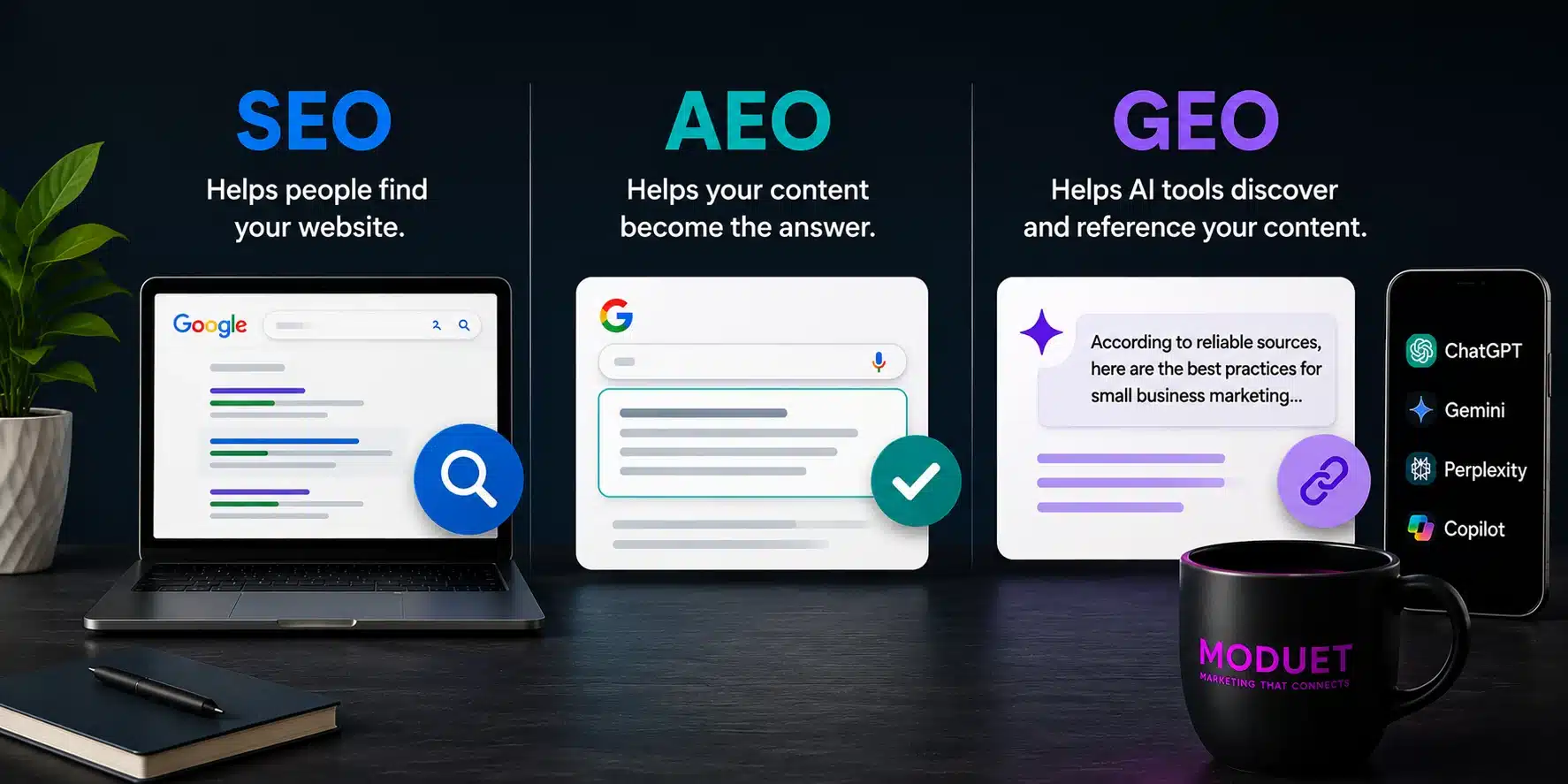
SEO helps search engines find and rank your content.
AEO helps search engines identify and display specific answers.
GEO helps AI systems understand, reference, and incorporate your content into generated responses.
They serve different purposes, but they are not isolated from one another.
A well written article about local SEO could rank in Google through SEO.
The same article could appear in a featured answer through AEO.
That same content could also contribute to an AI generated response through GEO.
The underlying principle remains remarkably similar.
Create useful content that answers real questions.
The delivery mechanisms have changed, but the value of helpful information has not.
Do You Need All Three?
Technically, yes.
Practically, most businesses should focus on building a strong foundation rather than treating SEO, AEO, and GEO as separate projects.
Many small and midsize businesses are still missing basic website elements that affect visibility across every search platform.
Their service pages are thin.
Their content is outdated.
Their website loads slowly.
Important customer questions go unanswered.
Fixing those issues often produces greater results than chasing the latest trend.
A company that consistently publishes useful content, maintains a healthy website, and answers customer questions is already moving in the right direction.
The same practices that support traditional search visibility often improve performance in answer engines and AI powered search environments as well.
That is why web design, content creation, SEO, and digital marketing strategy are increasingly connected.
A website is no longer just a digital brochure.
It is a knowledge source that search engines and AI systems use to understand your business.
What’s Next for Search?
The future of search is likely to include a mix of traditional search engines, answer based experiences, and AI generated responses.
Google is not disappearing.
Neither are websites.
What is changing is how users interact with information.
People want answers faster.
They expect search experiences to be more conversational.
They increasingly trust tools that summarize information and help them make decisions quickly.
Businesses that adapt to those expectations are likely to have an advantage.
That does not mean abandoning SEO.
It means expanding your approach.
The companies that perform best over the next several years will likely be those that create useful content, maintain technically sound websites, answer customer questions clearly, and build authority within their industries.
Whether someone finds you through Google, an AI overview, ChatGPT, or another platform that has not even been released yet, those fundamentals remain valuable.
Frequently Asked Questions
Is SEO still important in 2026?
Absolutely. SEO continues to be one of the most effective ways to attract qualified traffic from people actively searching for products and services. While search experiences are evolving, SEO remains the foundation of online visibility.
Is GEO replacing SEO?
No. GEO builds upon many of the same principles that support strong SEO. Businesses should view GEO as an extension of their visibility strategy rather than a replacement for traditional search optimization.
What is the difference between AEO and GEO?
AEO focuses on helping content become a direct answer to user questions. GEO focuses on helping AI systems discover, understand, and reference content within generated responses.
Do small businesses need to optimize for AI search?
Businesses should pay attention to AI search, but most will benefit more from improving content quality, website structure, and customer focused information before developing a dedicated GEO strategy.
Can one piece of content support SEO, AEO, and GEO?
Yes. In many cases, the same article can rank in search engines, appear in answer based search features, and contribute to AI generated responses when it is well written and structured.
Want to Learn More About SEO?
Understanding the differences between SEO, AEO, and GEO is helpful, but most businesses benefit from a deeper understanding of how search actually works.
If you want a more comprehensive look at ranking factors, content strategy, technical SEO, and practical ways to improve your visibility, explore our SEO pillar page: SEO for Growing Businesses: What Actually Works.
Curious About GEO and AI Search?
GEO is still a new concept for many organizations, but it is becoming an important part of the conversation around online visibility.
For a deeper look at how AI powered search works and what businesses can do to prepare, read: What Is GEO and Why It Matters for Your Business in 2026.
Still Have Questions?
Search continues to evolve, and new questions emerge every year.
If you’re looking for quick answers about SEO, rankings, websites, content strategy, and search visibility, visit our SEO FAQ Hub where we address many of the questions business owners ask most often.
The more you understand how people search, the easier it becomes to build a website and marketing strategy that helps them find you.

We Want To Talk To You About Your Marketing Goals.
Let’s Supercharge Your Online Growth!
By submitting the form, you agree to the Terms of Service and Privacy Policy
We Want To Talk To You About Your Marketing Goals.
Let’s Supercharge Your Online Growth!