Share this article

Getting people to your website is only part of the challenge.
You can invest in SEO, run paid ads, stay active on social media, and publish great content. But if visitors arrive and leave without taking action, all that effort starts to feel wasted.
This is something we see all the time. A business owner tells us their website traffic looks decent, but inquiries are inconsistent. Or they are getting clicks from Google, yet those visits are not turning into leads, sales, or phone calls.
When that happens, the problem is not always traffic. More often, the issue is what happens after someone lands on the site. In many cases, the same underlying issues show up as warning signs elsewhere on a website. If you’re seeing low engagement, you may also want to read our article on 5 Signs Your Website Is Hurting Your Business.
The good news is that most website performance issues are fixable once you know what to look for.

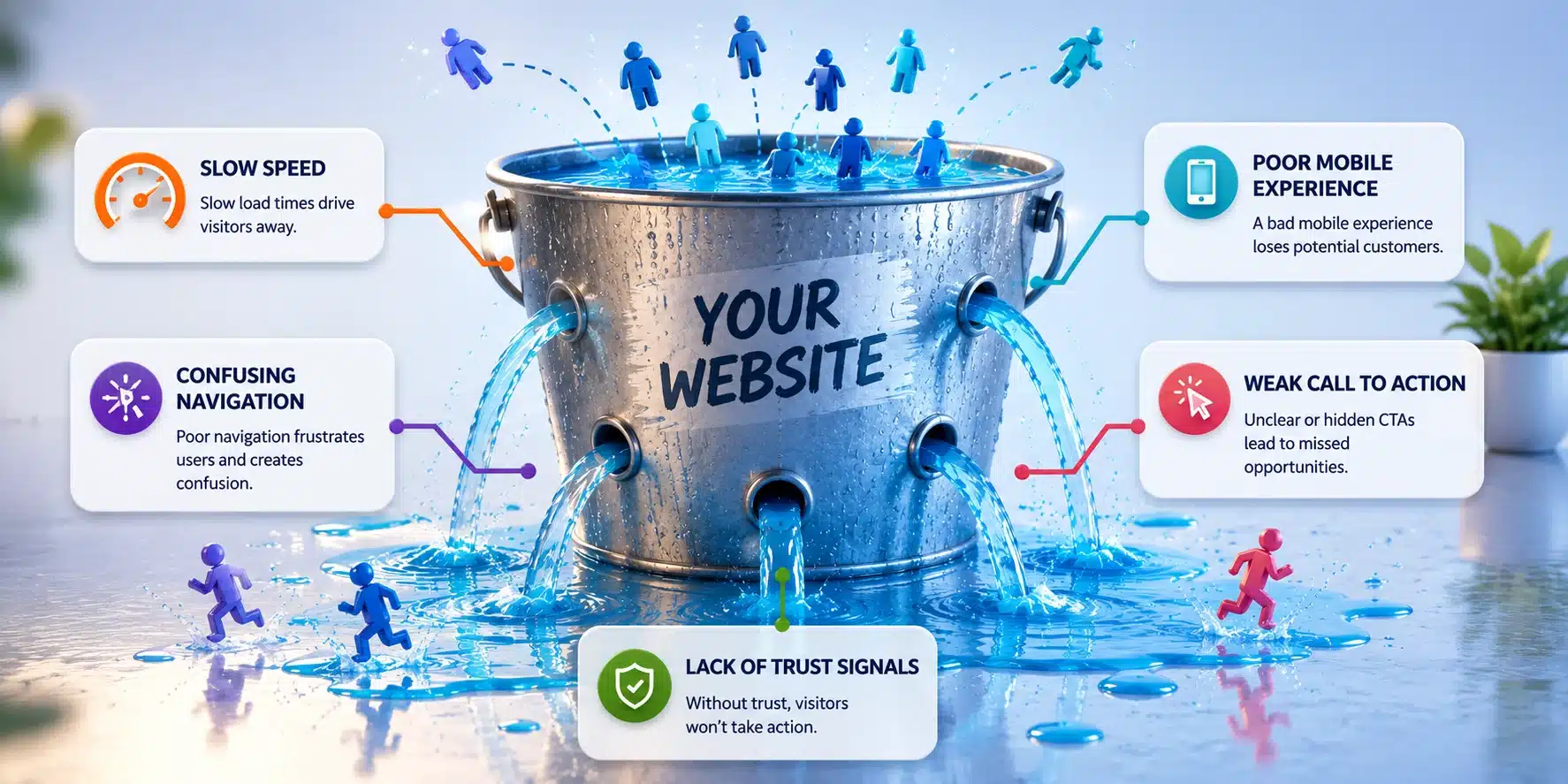
Your Website Takes Too Long to Load
We’ve all done it.
You click on a website, wait a few seconds, and decide it is not worth sticking around.
Your visitors are no different.
People expect websites to load quickly, especially on mobile devices. If a page feels slow, many users will leave before they even see your content.
The frustrating part is that businesses often spend money driving traffic to a website that is quietly pushing visitors away because of speed issues.
Large image files, outdated hosting, excessive plugins, and bloated code are some of the most common culprits.
Improving page speed is rarely the most exciting project, but it can have a surprisingly large impact on both user experience and search visibility.
Visitors Are Not Sure What You Do
This sounds obvious, but it is one of the most common problems we encounter.
A visitor lands on your homepage and immediately starts asking questions.
What does this company do?
Who is this for?
Why should I care?
If those answers are not clear within the first few seconds, people move on.
Many businesses try so hard to sound unique that they forget to be clear. Industry jargon, vague messaging, and clever headlines often create confusion instead of interest.
Your homepage does not need to tell your entire story. It simply needs to help visitors understand they are in the right place.
Clear messaging consistently outperforms clever messaging.
Your Website Looks Outdated
Fair or not, people make decisions based on appearance.
An outdated website can create doubt before a visitor reads a single sentence.
That does not mean every business needs a flashy redesign every couple of years. It does mean your website should feel current, professional, and easy to use.
Think about the last time you visited a website that looked like it had not been updated in a decade. You probably questioned whether the business was still active.
Your visitors are doing the same thing.
Strong web design builds trust. It reassures people that your business is legitimate, established, and invested in providing a good customer experience. If you’re considering a redesign, our guide on What to Look for When Hiring a Web Design Agency can help you evaluate potential partners and avoid common mistakes.
The User Experience Is Making Things Harder Than It Needs To Be
Sometimes visitors want to take action, but the website gets in their way.
Maybe the navigation is confusing. Maybe the contact form asks for too much information. Maybe the call to action is buried halfway down the page.
None of these issues seem major on their own. Together, they create friction.
Every extra click, every unnecessary field, and every moment of confusion increases the chances that someone will leave.
The best websites feel effortless. Visitors know where to go, what to do next, and how to contact you without having to think about it.
That simplicity often makes a bigger difference than businesses realize.
Your Content Is Attracting the Wrong Audience
Traffic numbers can be misleading.
A page might receive hundreds or even thousands of visits each month and still generate very few leads.
Why?
Because not all traffic is valuable.
Imagine a roofing company ranking for broad informational searches that attract homeowners looking for DIY advice. Those visitors may read an article and leave because they were never looking to hire a contractor in the first place.
This is where search intent matters.
Effective SEO is not about attracting the largest possible audience. It is about attracting the right audience.
When content aligns with what visitors are actually looking for, engagement improves and conversions become much more likely.
Your Mobile Experience Needs Work
For many businesses, mobile traffic now accounts for more than half of all website visits.
Yet mobile optimization is still treated like an afterthought.
A page that looks great on a desktop monitor can feel frustrating on a phone. Text may be difficult to read. Buttons may be too small. Forms may be awkward to complete.
Visitors rarely complain about these issues. They simply leave.
That is why mobile testing should be an ongoing part of website maintenance, not something that only happens during a redesign project.
Visitors Do Not Trust You Yet
Trust is one of the biggest factors in whether someone converts.
A potential customer may like your services, understand your offer, and even agree with your pricing. But if they are not fully confident in your business, they may hesitate to take the next step.
This is where social proof becomes important.
Testimonials, reviews, case studies, client logos, certifications, and real examples of your work help reduce uncertainty.
Think of it this way. Every visitor arrives with questions.
Can this company actually help me?
Have they done this before?
Can I trust them?
Your website should answer those questions before they need to ask.
Small Improvements Can Lead to Big Results
One of the biggest misconceptions about website performance is that fixing low conversions requires a complete redesign.
Sometimes it does.
More often, it doesn’t.
A faster website. Clearer messaging. Better calls to action. Stronger trust signals. Simpler navigation.
Small improvements in several areas often produce better results than one dramatic change.
The most successful websites are not built around a single feature or tactic. They work because every element supports the same goal: helping visitors move confidently from interest to action.
Final Thoughts
If your website is losing visitors, do not assume you need more traffic.
Start by looking at the experience people have once they arrive.
Are pages loading quickly? Is your message clear? Does the site feel trustworthy? Is it easy to take the next step?
The answers to those questions often reveal opportunities that are far more valuable than simply attracting more visitors.
Many of these issues stem from the same core principle: successful websites are built around the needs of the user, not just the preferences of the business. To learn more about the elements that contribute to long-term website performance, read our guide What Makes a Website Actually Work for Your Business.
At MoDuet, we help businesses identify what is holding their websites back and uncover practical ways to improve performance. Whether the challenge involves web design, SEO, content strategy, or user experience, sometimes a few thoughtful changes can make all the difference.

We Want To Talk To You About Your Marketing Goals.
Let’s Supercharge Your Online Growth!
By submitting the form, you agree to the Terms of Service and Privacy Policy
We Want To Talk To You About Your Marketing Goals.
Let’s Supercharge Your Online Growth!