Share this article

Your website should be helping your business, not quietly working against it.
For many people, it is the first place they go before deciding whether to contact you, buy from you, book a service, or even trust your company. They may find you through Google, a social media post, a referral, or an ad. Either way, your website often becomes the moment of truth.
And that moment happens fast.
A strong website can make your business look credible, clear, and easy to work with. A weak one can create doubt before you ever get a chance to have a conversation. To learn more about the elements that separate high-performing websites from underperforming ones, read our guide What Makes a Website Actually Work for Your Business.
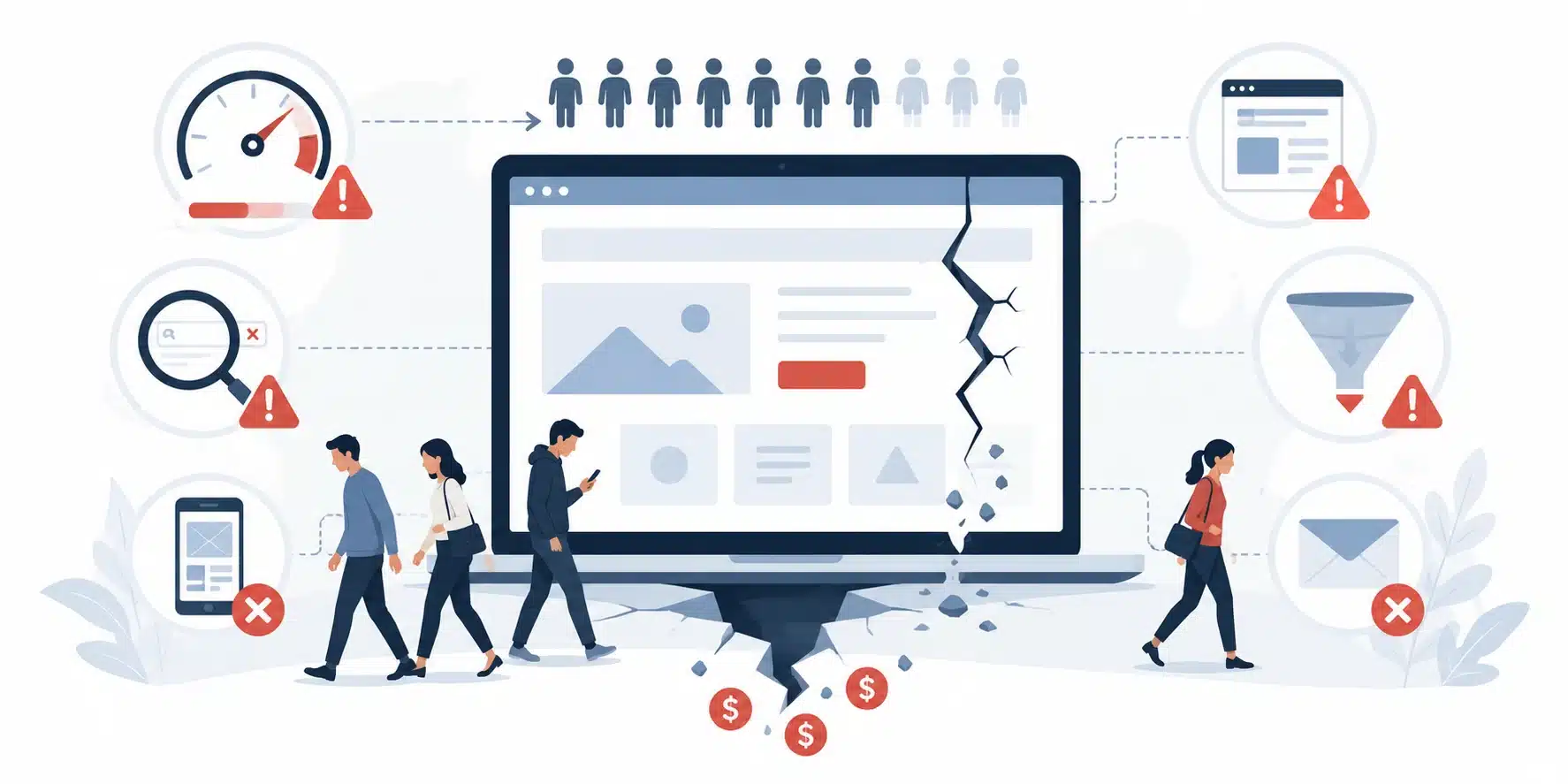
If leads are slowing down, inquiries feel inconsistent, or people are visiting your site but not taking action, your website may be part of the problem. Here are five signs your website is hurting your business and what to look for before it costs you more opportunities.

1. People Visit Your Website but Do Not Take Action
Traffic is good, but traffic alone does not grow a business.
If people are landing on your website and leaving without calling, filling out a form, scheduling a consultation, or making a purchase, something is getting in the way.
Sometimes the issue is the message. Visitors arrive and still do not understand what you offer or who you help. Other times, the next step is buried too far down the page. Maybe the contact button is hard to find. Maybe the form asks for too much information. Maybe the page simply does not give people enough reason to act.
A website should guide visitors, not make them figure everything out on their own.
Here is how this often shows up
A home services company invests in local SEO and starts getting more visitors to its website. On paper, that sounds like progress. But the phone is not ringing more often, and form submissions are still low.
After reviewing the site, the problem becomes clear. The homepage talks about the company, but it does not clearly explain the services, service area, or next step. The contact form is also hidden on a separate page with no strong invitation to use it.
How to improve it
Look at each important page and ask one simple question: what should someone do next?
That next step should be clear. It could be requesting a quote, booking a call, downloading a guide, visiting a service page, or contacting your team. Whatever it is, make it easy to find and easy to complete.
2. Your Website Looks Outdated
People absolutely judge a business by its website.
That may not feel fair, especially if your company does great work, but it is true. If your website looks outdated, cluttered, or poorly maintained, visitors may assume the same about your business.
This does not mean your site needs to look flashy or follow every design trend. In fact, that can backfire. What matters is that it feels current, organized, and aligned with the level of professionalism you want people to associate with your brand.
Design builds trust before people read a single paragraph.
Here is how this often shows up
A consulting firm has strong referrals and years of experience, but its website has not been updated in nearly a decade. The logo is blurry, the colors feel inconsistent, and the mobile version is difficult to navigate.
Nothing about the business itself is outdated. But online, that is the impression people get.
How to improve it
Start with the basics. Make sure your website works well on mobile, uses current brand visuals, has clean page layouts, and makes key information easy to find.
A full redesign may be the right move in some cases. In others, small updates to imagery, spacing, typography, and page structure can make the site feel much more polished. If you are considering a redesign, our article What to Look for When Hiring a Web Design Agency can help you identify the right partner for the project (https://moduet.com/what-to-look-for-when-hiring-a-web-design-agency/).
3. Your Website Is Slow or Unreliable
People are impatient online.
If your website takes too long to load, many visitors will leave before they ever see what you offer. That is especially true on mobile, where people may be browsing between meetings, errands, or quick searches.
Speed also affects more than user experience. A slow website can hurt your visibility in search results, making it harder for potential customers to find you in the first place.
And then there is reliability. If your site goes down often, shows errors, or has broken pages, it creates the kind of friction that makes people question whether they should trust you.
Here is how this often shows up
A contractor has a beautiful project gallery, but every image was uploaded at full size. The page looks great once it loads, but it takes several seconds to appear. On a phone, it feels even slower.
Instead of waiting, visitors bounce back to Google and click on a competitor.
How to improve it
Website performance should be checked regularly, not only when something breaks.
Optimized images, strong hosting, clean code, plugin updates, and technical SEO all play a role. This is why web design, hosting, and search optimization should not be treated as completely separate pieces. They affect each other.
A beautiful website still needs to work well.
4. Your Content Does Not Answer Real Customer Questions
Many websites talk a lot, but say very little that helps the visitor.
They explain that the company is experienced, professional, dedicated, and committed to quality. Those things may be true, but they are also vague. Your potential customers are usually looking for something more specific.
They want to know if you understand their problem. They want to know what the process looks like. They want to know what makes you different, how much they need to prepare, what kind of results they can expect, and why they should choose you over someone else.
If your website does not answer those questions, people may keep searching.
Here is how this often shows up
A digital marketing agency has service pages for SEO, web design, branding, and content creation. The pages describe each service in broad terms, but they do not explain who the service is best for, what problems it solves, or how the agency approaches the work.
A visitor may understand that the agency offers SEO. But they still do not know whether that SEO support is right for their business.
How to improve it
Write for the person making the decision.
Service pages should be clear and practical. Blog content should answer real questions your audience is already asking. FAQs, case studies, process pages, and educational resources can all help build confidence.
Good content does more than fill space. It helps visitors feel informed enough to take the next step.
5. Your Website Is Hard to Find on Google
A website can look great and still fail if nobody finds it.
Many businesses launch a website and assume people will naturally discover it. But search visibility takes strategy. Without SEO, your website may not show up when potential customers search for your services.
This is one of the most common ways a website hurts a business. Not because the site is broken, but because it is invisible.
If competitors appear ahead of you in search results, they are getting opportunities you may never even know you lost.
Here is how this often shows up
A local business launches a new website and expects more inquiries. The design is clean, the services are listed, and the brand looks professional. Months later, traffic is still low.
The issue is not the appearance of the site. It is that the pages were never optimized for the right keywords, locations, or customer questions.
How to improve it
SEO should be part of your website strategy from the beginning.
That includes keyword research, page structure, technical SEO, local SEO, internal linking, and ongoing content creation. The goal is not just to bring in more traffic. The goal is to attract the right people, at the right moment, with the right message.
Why These Website Problems Matter
A website issue may seem small on its own.
A slow page. A vague headline. An outdated image. A missing call to action. A service page that does not rank.
But together, those small issues can quietly cost your business leads, credibility, and revenue.
The hardest part is that website problems are not always obvious from the inside. You know your business. You know what you offer. You know how to contact your team. New visitors do not.
That is why your website needs to be built around their experience, not just your internal understanding of the business.
Your Website Should Be Working for You
Your website should do more than sit online.
It should help people find your business, understand what you offer, trust your expertise, and take the next step with confidence.
If any of these signs sound familiar, it may be time to take a closer look at how your website is performing. Sometimes a few updates to your messaging, design, or user experience can make a noticeable difference. Other times, your business may need a bigger improvement across web design, SEO, content, hosting, or overall digital strategy.
If visitors are leaving your site before taking action, our article Why Your Website Is Losing Visitors (And How to Fix It) takes a deeper look at the common causes of abandonment and what businesses can do to improve engagement.
Either way, the goal is the same: turn your website into a business asset, not a source of missed opportunities.
If you are not sure whether your website is helping or hurting your business, MoDuet can help you take an honest look at what is working, what is getting in the way, and what steps could make the biggest impact.
We Want To Talk To You About Your Marketing Goals.
Let’s Supercharge Your Online Growth!
By submitting the form, you agree to the Terms of Service and Privacy Policy
We Want To Talk To You About Your Marketing Goals.
Let’s Supercharge Your Online Growth!