Share this article

Imagine you spend three months developing a campaign. The creative is strong. The message resonates with your English-speaking audience. You’re confident it’s going to work. Then you hand it off for Spanish translation, run the ads, and nothing happens. Low engagement. Poor conversion. Crickets.
The product wasn’t the problem. The message wasn’t the problem. The translation was.
This happens more often than most brands want to admit, and it almost always comes down to one thing: using translation when the job called for transcreation.

What is translation
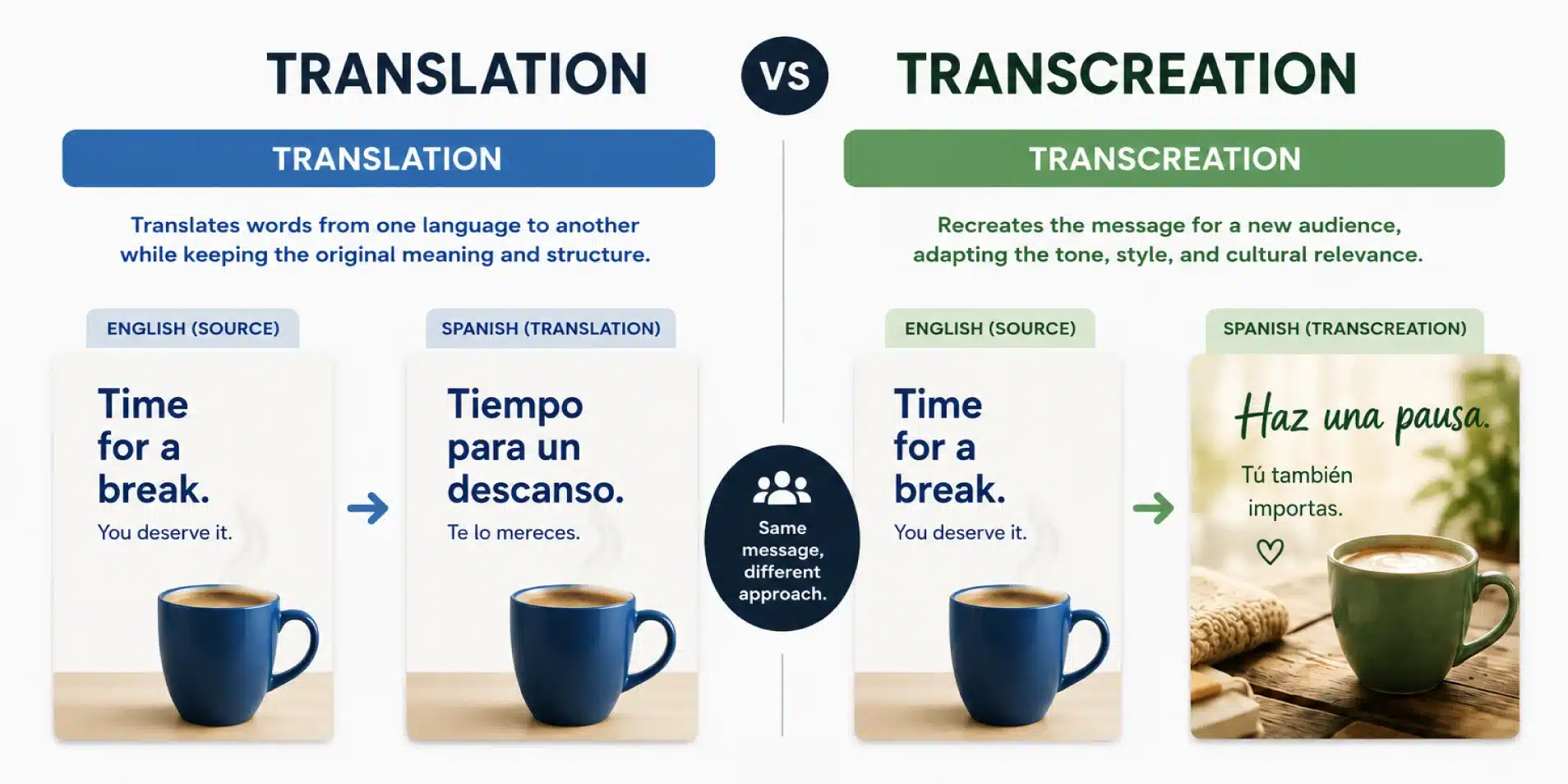
Translation is the process of converting content from one language to another while preserving the original meaning as closely as possible. It’s accurate. It’s efficient. And for the right type of content, it’s exactly what you need.
Legal documents, terms and conditions, product specifications, technical manuals, FAQs with straightforward answers. These are all great candidates for translation. The goal is clarity and accuracy, not emotional connection.
The problem starts when brands use translation for content that was designed to do more than inform. Content that was designed to persuade, inspire, or connect. That’s a different job, and it requires a different tool.
What is transcreation
Transcreation is the process of taking a message and rebuilding it in another language and culture from the ground up. The goal isn’t to preserve the original words. The goal is to preserve the original intent, tone, and emotional impact.
Here’s a simple way to see the difference.
A financial brand runs an English campaign with the tagline: “Your future starts today.” Clean, optimistic, forward-looking. Works well in English.
A direct translation into Spanish gives you: “Tu futuro empieza hoy.” Technically correct. But it doesn’t carry the same weight with a first-generation immigrant who thinks about the future very differently than the campaign assumed. The cultural context around concepts like financial planning, security, and the future can be very different for someone navigating life in a new country.
A transcreated version might use completely different words, a different metaphor, a different emotional entry point. But it lands. It connects. It converts.
That’s the difference.
How to know which one you need
A simple framework: if the content needs to inform, translate. If it needs to persuade, inspire, or connect emotionally, transcreate.
Here’s how that plays out in practice:
- Translate: Terms and conditions, privacy policies, product descriptions with specs, technical documentation, straightforward FAQs, order confirmation emails.
- Transcreate: Ad headlines and taglines, homepage hero copy, brand storytelling, social media captions, email subject lines, campaign slogans, video scripts, anything with humor or wordplay.
When in doubt, ask yourself: would a word-for-word swap change how this feels? If yes, you need transcreation.
Common mistakes
Transcreating when you should translate. Not everything needs a creative overhaul. Over-engineering a return policy or a product spec sheet is a waste of budget. Save transcreation for the content that has to move people.
Translating when you should transcreate. This is the more common and more costly mistake. Running an emotionally-driven campaign through Google Translate and calling it Hispanic marketing. The words are technically in Spanish. The message is gone.
Treating transcreation as an afterthought. Transcreation works best when it’s built into the campaign from the beginning, not added at the end. If you’re creating content in English and then asking someone to “make it work in Spanish,” you’re already starting from the wrong place. The best multilingual campaigns are developed with all target audiences in mind from day one.
What good transcreation actually looks like
Transcreation isn’t magic. It’s a process. And it involves more than finding someone who speaks both languages.
Good transcreation starts with a brief. What is the original message trying to do? What emotion should it evoke? What action should it drive? What does the audience value, and how does that shape the way the message should land?
From there, a skilled transcreator isn’t just translating. They’re writing. They’re making creative decisions about tone, metaphor, rhythm, and cultural reference. The output might look nothing like the original. That’s not a failure. That’s the job done right.
The result is content that a Spanish-speaking consumer reads and thinks: this was made for me. Not: this was translated for me.
That gap, between “made for me” and “translated for me,” is where brands either win or lose the trust of Hispanic audiences.
Where to go from here
Translation and transcreation are both valuable. The key is knowing which one serves the moment. Get that right, and your message travels across languages without losing what made it work in the first place.
If you want to go deeper on building a full Hispanic marketing strategy, start with our complete guide to Hispanic marketing in the US.
And if you’re ready to put transcreation to work for your brand, let’s talk.

We Want To Talk To You About Your Marketing Goals.
Let’s Supercharge Your Online Growth!
By submitting the form, you agree to the Terms of Service and Privacy Policy
We Want To Talk To You About Your Marketing Goals.
Let’s Supercharge Your Online Growth!