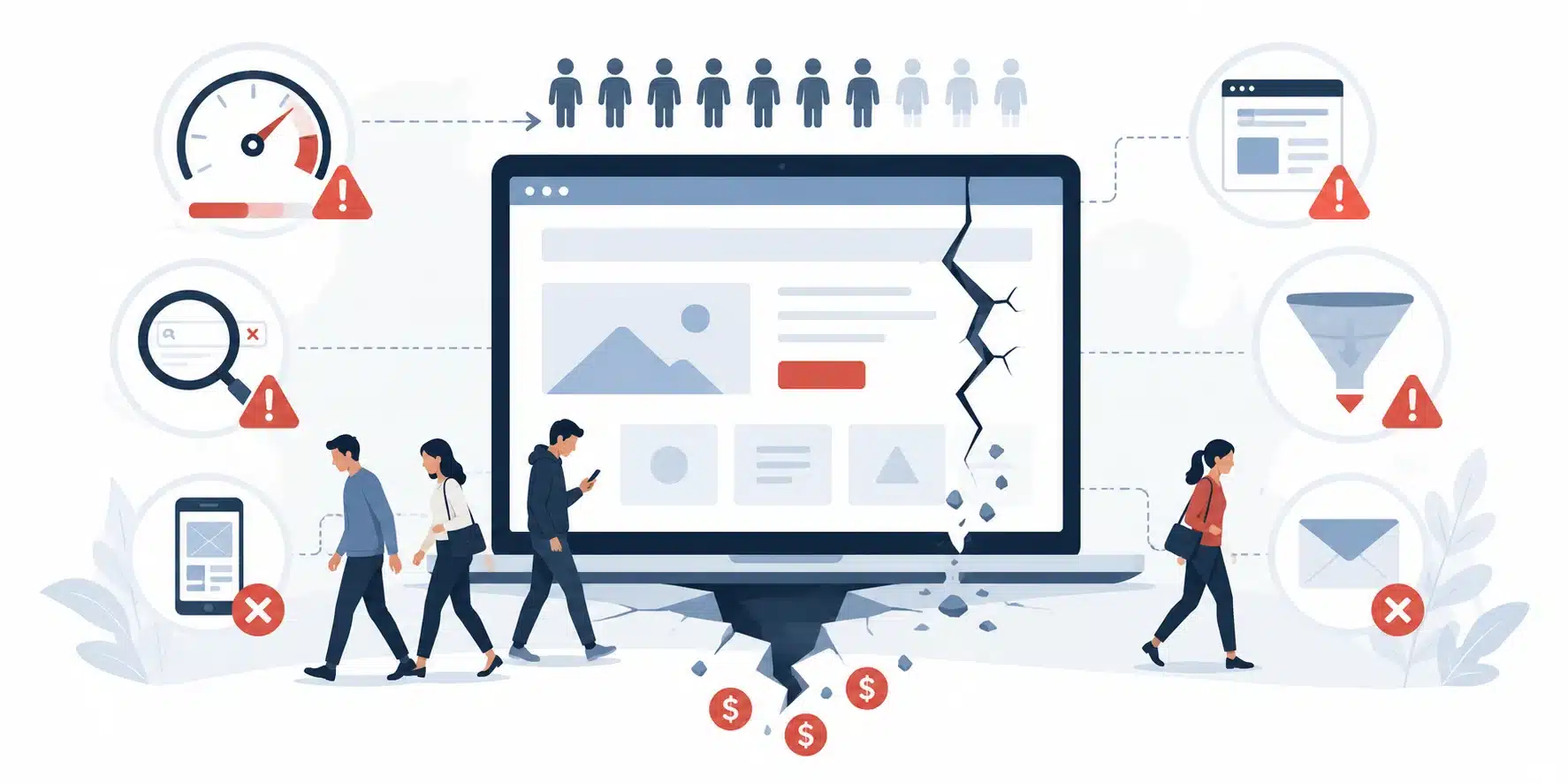
The Pros and Cons of Analyzing Competitor Website Data
The Pros and Cons of Analyzing Competitor Website Data
Competitor research can reveal SEO gaps, content opportunities, and website improvements. Learn what competitor analysis tools can reliably tell you, where their estimates fall short, and how to use the findings.


It’s tempting to look at a competitor’s website and wonder what they’re doing that you’re not.
Maybe they appear above you in Google. Their website looks more polished. They’re publishing content regularly, or a competitive analysis tool suggests they’re getting considerably more traffic than you.
Naturally, you want to know why.
Competitor website analysis helps you identify gaps in your SEO, content, messaging, and online customer experience. It can reveal useful opportunities, but the conclusions are only as reliable as the information behind them.
Some things you can observe directly. Others, including a competitor’s traffic and keyword performance, are often estimates. And there are important business results you simply cannot determine by looking at another company’s website.
Knowing the difference is what makes competitive research worthwhile.
What Is Competitor Website Analysis?
Competitor website analysis is the process of examining other businesses’ websites to understand how they position their services, attract visitors, organize information, and compete for online visibility.
Depending on your goals, you might review their:
- Search engine visibility and relevant keywords.
- Service pages and content topics.
- Website structure and navigation.
- Calls to action and lead generation methods.
- Mobile usability and page performance.
- Publicly visible offers, pricing, and business information.
The objective is to identify opportunities to improve your own website.
For example, a commercial cleaning company might discover that several competitors have detailed pages explaining services for medical facilities, while its own website only lists “commercial cleaning.”
That observation doesn’t establish which competitor is generating more leads.
It does raise a useful question: are potential customers finding enough information on your website to understand whether you serve their industry?
That’s something you can investigate and improve.
The Pros of Analyzing Competitor Website Data
1. Identify SEO Opportunities You May Be Missing
One of the strongest reasons to study competitors is to understand which businesses are appearing for searches relevant to your customers.
Look at the terms people might use when researching your services. Review the pages Google displays and how those pages answer the search.
You may find competitors addressing service categories, locations, or customer questions your website has overlooked.
SEO tools can also estimate which keywords drive organic visibility for competing domains.
Those estimates can help you investigate promising topics, but they don’t confirm how many actual visits or customers a competitor receives.
Focus on Search Intent
Suppose you operate a roofing company and notice competitors have separate pages for roof repairs, inspections, and replacements.
Before creating three new pages, consider whether each service represents a distinct customer need.
If the answer is yes, dedicated pages may make it easier for customers to understand your services and find relevant information.
If the pages would repeat nearly identical content, creating them simply because competitors have them may accomplish very little.
The opportunity comes from addressing a genuine information gap.
For more on how search visibility works, see SEO, AEO, and GEO: What’s the Difference and Why Should You Care?.
2. Improve Your Content Strategy
Competitor research can reveal topics and questions being addressed elsewhere in your industry.
It can also expose weaknesses.
Perhaps every competing website provides the same introductory explanation of a service, but none explains how customers should evaluate their options.
That may be an opportunity to create something genuinely useful.
A detailed comparison, a straightforward buying guide, or an explanation of common service limitations could help customers make a better decision.
Avoid assuming that a competitor’s frequently published content is automatically effective.
You can see what they’ve published. You generally can’t see how many qualified leads the content generated or whether the investment was profitable.
Use the research to generate questions worth answering, then evaluate those questions against what you know about your own customers.
3. Find Ways to Differentiate Your Business
Competitor websites are useful for understanding how businesses describe themselves.
You may notice several companies using nearly identical messaging: excellent service, experienced professionals, competitive pricing.
Those claims aren’t necessarily false, but they don’t give customers much help distinguishing between providers.
Look for information competitors leave unclear.
Do they explain their process? Identify which customers they serve best? Show relevant qualifications? Describe what happens after someone requests a quote?
Then review whether your own website communicates those details effectively.
Differentiation doesn’t always require an entirely new service.
Sometimes it comes from explaining an existing advantage more clearly.
4. Evaluate Your Website’s Customer Experience
You can learn from how competitors structure their websites without copying their designs.
Compare how easily someone can find services, understand an offer, and complete a contact form.
Review mobile navigation, page layouts, important calls to action, and the clarity of service information.
You may find a competitor offering a simpler quote request process or more helpful product filtering.
That doesn’t prove their website converts better than yours.
But it gives you something specific to evaluate.
If customers regularly struggle with the same task on your website, improving that experience may be worthwhile regardless of what competitors are doing.

The Cons and Limitations of Competitor Website Analysis
1. Traffic Estimates Are Not Actual Analytics
This is one of the most important limitations to understand.
Tools such as Semrush and Similarweb can estimate competitor traffic using different methodologies.
For example, Semrush explains that some of its traffic estimates are based on keyword rankings and predicted click-through rates, while its Traffic Analytics estimates use clickstream data.
These approaches can produce different numbers for the same domain.
You can review Semrush’s explanation of traffic estimates and Similarweb’s data methodology.
Both are useful references for understanding what the tools actually measure.
An estimated 20,000 monthly visits shouldn’t be presented as though someone gave you access to the competitor’s Google Analytics account.
It’s an estimate.
Smaller websites may also have limited or less reliable competitive data because there may not be enough information available to support detailed estimates.
2. You Can’t See the Competitor’s Full Business Results
Even if a competitor receives more website traffic, you don’t know how much of it becomes revenue.
You generally cannot determine:
- How many qualified leads their website generates.
- What percentage of those leads become customers.
- How much they spend producing their content.
- Their profit margins or customer acquisition costs.
- Whether the website is meeting their business objectives.
A competitor could receive substantially more traffic than your business while struggling to convert it into paying customers.
Or they could attract relatively few visitors and generate profitable sales through a highly specialized service.
Traffic alone doesn’t settle the question.
3. Copying Competitors Can Lead to the Wrong Investments
What works for another business may depend on its budget, reputation, customer relationships, or operational capabilities.
A national company may support an extensive content program with a dedicated marketing team.
A local service provider might have far more success maintaining strong service pages and building relationships with referral partners.
Trying to reproduce the national company’s publishing schedule could consume resources without producing comparable benefits.
The same applies to design.
A competitor may have a visually elaborate website because its audience expects extensive product exploration.
Your customers may prefer a straightforward page that explains your services and provides a phone number.
The better website is the one that serves its customers effectively.
4. Competitive Research Can Consume Too Much Time
There’s a point where monitoring competitors stops helping.
If every new page, blog post, or design adjustment triggers another round of research, your business can spend more time reacting than improving.
Not every competitor change deserves a response.
A redesigned homepage doesn’t necessarily indicate a successful strategy. A sudden increase in estimated traffic may reflect seasonality, changes in the tool’s data, or a temporary event.
Research should inform your decisions without becoming an ongoing distraction.
What Competitor Data Can You Actually Trust?
Different sources offer different levels of certainty.
Understanding those differences helps prevent weak assumptions from turning into expensive decisions.
| Information | What You Can Know | Main Limitation |
|---|---|---|
| Public website content | Services, messaging, page structure, visible offers | Doesn’t reveal actual performance |
| Search results | Which pages appear for specific searches | Results vary by location, query, and other factors |
| SEO tool keyword estimates | Potential keyword visibility and estimated traffic | Based on third-party models |
| Third-party traffic estimates | Approximate traffic patterns and comparisons | Not direct access to competitor analytics |
| Public page performance tests | How a page performs under tested conditions | May not represent every visitor’s experience |
| Your own Google Analytics and Search Console | Measured behavior and search performance for your property | Depends on tracking, available data, and reporting limitations |
For your own website, Google Search Console and Google Analytics provide a stronger basis for evaluating results.
Google explains that these tools measure different parts of the visitor journey, so their numbers may not match exactly.
For competitor websites, treat modeled data as a starting point for investigation rather than a financial performance report.
How to Conduct a Useful Competitor Website Analysis
You don’t need a complicated research process to get started.
A focused review of three to five relevant competitors can provide enough information to identify several useful opportunities.
Step 1: Choose Competitors That Matter
Start with businesses offering similar services to similar customers.
Include direct competitors, but also consider businesses that consistently appear for searches important to your company.
These may not be the same.
A local contractor might compete for customers with nearby businesses while competing in Google results with directories, review platforms, and larger companies.
Decide which type of competition you’re analyzing before drawing conclusions.
Step 2: Define What You Want to Learn
Avoid reviewing websites without a specific question.
Are you trying to understand why competitors appear for certain searches?
Do you want to improve your service pages? Compare customer experiences? Find useful content opportunities?
Choose a clear objective.
For example, if you’re reviewing SEO opportunities, focus on relevant search results, service-page coverage, and content gaps.
There’s little value in spending hours evaluating competitors’ social media icons when your real concern is organic search visibility.
Step 3: Review Publicly Available Information
Look at how each competitor presents its business.
Consider the clarity of the main message, service descriptions, navigation, customer resources, and contact options.
Use reputable tools when estimates or technical comparisons would add value.
Keep the research ethical.
Publicly available information is generally the appropriate starting point. Don’t attempt to access private analytics, restricted systems, customer records, or confidential business information.
Also respect applicable website terms and restrictions when gathering data.
Step 4: Compare Findings With Your Business Goals
A finding matters only if it connects to something your business needs to improve.
Suppose competitors provide detailed answers to questions about service costs, while your website offers no pricing guidance.
That might indicate an opportunity to explain pricing factors more clearly.
But if your business uses custom proposals and cannot provide standard prices responsibly, copying a competitor’s pricing table may mislead customers.
The goal is to make your information more useful within the realities of your business.
Step 5: Prioritize Changes You Can Evaluate
Once you identify potential improvements, select a manageable number to investigate.
A straightforward approach is to classify each finding as:
- Act: A clear issue on your own website supported by customer needs or performance data.
- Test: A promising idea that requires more evidence.
- Monitor: An observation worth revisiting without immediate action.
For example, a broken mobile contact form belongs in the first category whether competitors have better forms or not.
A new content topic based on competitor research may need validation before your team invests in producing it.
This prevents competitive analysis from turning into an unlimited list of website changes.
How Often Should You Analyze Competitor Websites?
There is no universal schedule.
For many small businesses, a focused quarterly review is a reasonable starting point.
You may need to review more frequently when entering a new market, launching a significant service, or responding to a meaningful industry change.
Between reviews, pay attention to your own performance.
If you’re losing relevant search visibility, investigate changes in demand, website issues, and competitor activity rather than immediately assuming another company has taken your traffic.
Google’s guidance on investigating search traffic changes explains several possible causes, including seasonality, site changes, and search algorithm updates.
That context matters because competitors are only one possible explanation.
Turn Competitor Research Into Better Business Decisions
Competitor website analysis can help you understand where your business may be missing opportunities.
You can find relevant topics, evaluate how other companies present their services, and identify ways to improve your website.
But the research has limits.
Third-party estimates aren’t financial statements. A polished competitor website doesn’t prove strong conversion performance. And copying a strategy without understanding why it works is an expensive way to learn the wrong lesson.
Use competitive research to identify what deserves attention. Then validate the opportunity using your customers, your website, and your actual business results.
If you’re unsure how your website compares, MoDuet offers a free online presence and competitor analysis report. It can provide a starting point for reviewing visibility and identifying opportunities worth investigating.