Share this article

If you’re running ads right now, chances are you’re thinking about platforms separately. Google Ads over here. Facebook ads over there. Maybe some retargeting if you’ve had time to set it up.
The problem is your customers don’t think in platforms.
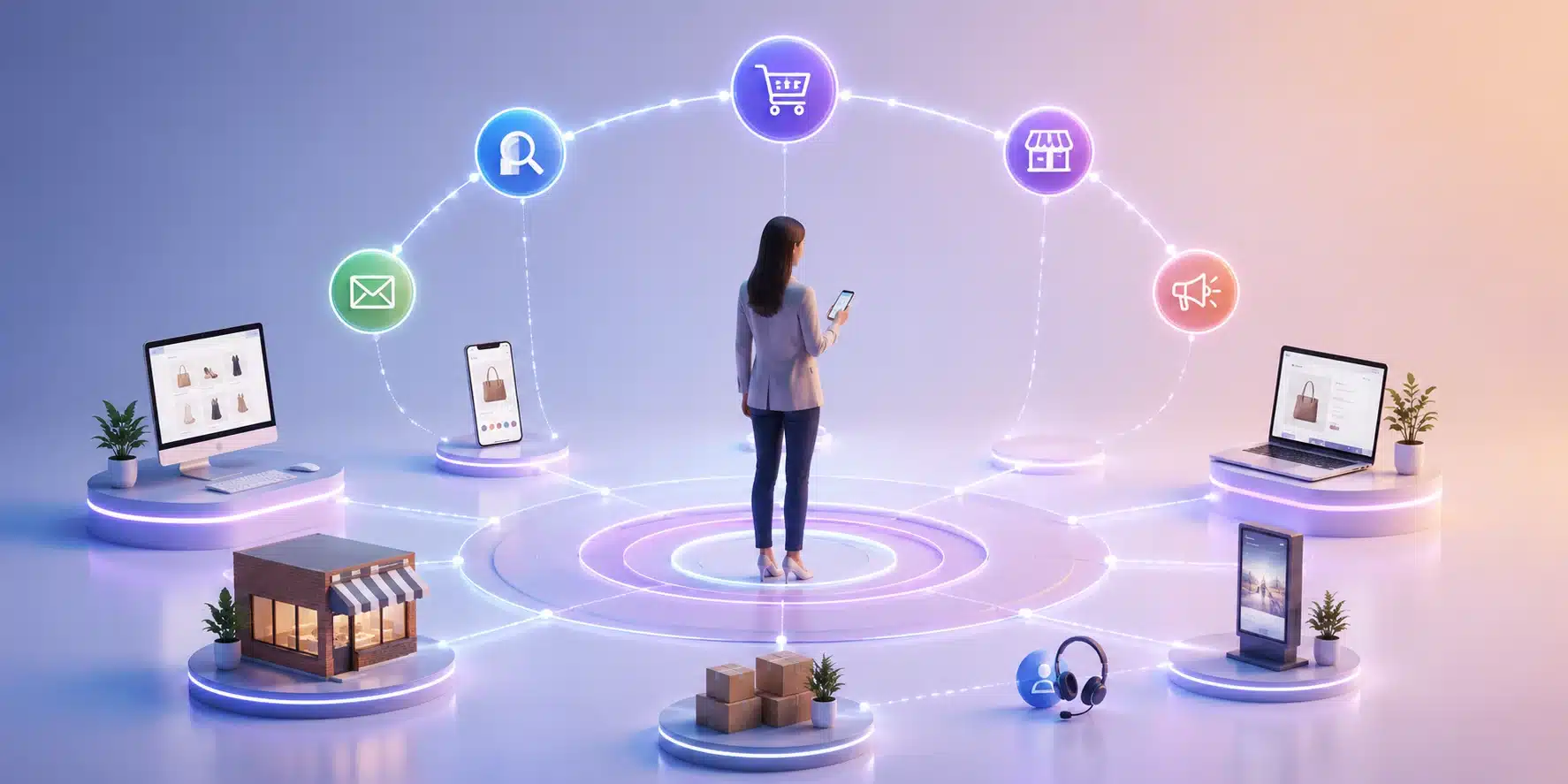
They search on Google in the morning, scroll Instagram at lunch, watch YouTube at night, and check reviews before bed. By the time they fill out your form or call your office, they’ve probably seen you multiple times in different places.
That’s where an omnichannel SEM strategy comes in. It’s not about being everywhere just for the sake of it. It’s about connecting those touchpoints so they work together instead of operating in isolation.
Let’s talk about how to build that in a way that actually drives conversions.

What Does “Omnichannel SEM” Actually Mean?
Let’s break this down without the jargon.
Search engine marketing, at its core, is about showing up when someone is actively looking for what you offer. Google Ads, Microsoft Advertising, product listing ads, local search placements. That is the traditional definition. Omnichannel just means you are not stopping there.
Think about how your own customers actually behave. Someone searches “best CRM for small business,” clicks your ad, reads your landing page for 45 seconds, and leaves. Two days later, they are scrolling LinkedIn and see your brand in a sponsored post. They recognize you. Later that week, they type your company name directly into Google. That full arc, from the first search to the branded return visit, is the customer journey. An omnichannel SEM strategy is what makes sure you are present and intentional across all of it, not just the first click.
The businesses winning at paid search right now are not always the ones with the biggest ad budgets. More often, they are the ones who understand where their customers go between searches and have built a presence there.
Start With Intent Before You Touch a Keyword
Most people building an SEM strategy start with keyword research. That is not wrong, but it can lead you astray if you are not thinking about intent first.
Someone who types “what is omnichannel marketing” is not ready to buy anything. They are learning. Someone searching “omnichannel SEM agency pricing” is very close to picking up the phone. Both are valuable searches, but they need completely different responses from you. If you send the first person to a contact form, they will bounce. If you send the second person to a blog post, you will lose them to a competitor who sent them to a sharp, conversion focused service page.
Search intent breaks down into four buckets: informational, navigational, commercial, and transactional. A good omnichannel SEM strategy maps content and landing experiences to each one. Awareness stage content builds credibility and captures early research traffic. Commercial stage pages give people the comparison and proof they need. Transactional pages get out of the way and make it easy to act.
Getting this mapping right also means your website has to be doing its part. A slow page, a confusing layout, or design that looks nothing like your ad copy will kill conversion rates no matter how good your targeting is.
Paid and Organic Are Not Separate Sports
This is where a lot of companies leave serious money on the table.
Paid search and SEO tend to live in different corners of the marketing budget, managed by different people with different goals. But when they are aligned, something interesting happens. Your paid search data tells you which keywords are actually driving conversions, not just traffic. That insight is gold for your content team. Meanwhile, organic rankings for high intent terms reduce your reliance on paid clicks and build long term authority that compounds over time.
Picture a local law firm running Google Ads for “personal injury attorney Chicago” while also ranking organically for that same phrase through consistent content and technical SEO work. A person searching that term sees the firm twice in one results page. That kind of visibility builds trust before anyone has even clicked a link. It signals that this firm is not just buying attention, they have earned it.
Consistent branding across both channels matters here too. If your ads have one voice and your website has another, that friction erodes confidence, subtly but surely.
Google Is Not the Only Game Worth Playing
Google owns the largest share of search traffic. But treating it as the only channel in your omnichannel SEM strategy is leaving reach, and revenue, on the table.
Microsoft Advertising runs on Bing, which has a smaller but often overlooked audience skewing toward older, higher income users and B2B decision makers. Cost per click is typically lower, and competition is thinner in a lot of industries. YouTube, the second largest search engine on the planet, lets you run video ads triggered by what people are actively searching for. And retargeting through Meta or display networks lets you stay in front of people who already showed interest after clicking one of your search ads.
None of this means you should spread your budget thin and show up everywhere. The question is where your specific customers go after that first search. Do they watch YouTube reviews? Do they ask peers on LinkedIn? Do they read comparison sites? Answering those questions tells you where your retargeting dollars should go, and that is where the omnichannel approach pays off. A plumbing company might discover that Facebook retargeting to people who visited their site but did not call converts at twice the rate of cold Google traffic. That is the kind of insight you only find when you are measuring the whole journey.
Landing Pages Can Make or Break Everything
You can write brilliant ad copy, nail your targeting, and still watch the budget drain with almost nothing to show for it. The culprit, more often than not, is the landing page.
A page that does not match the intent behind the ad creates cognitive friction. The visitor expected one thing, got another, and left in under ten seconds. The fix is not always a redesign. Sometimes it is creating dedicated, focused landing pages for each campaign instead of sending everyone to your homepage. Sometimes it is page speed, which genuinely kills conversions at a measurable rate. A page loading in two seconds versus five can mean two or three times the conversion rate, especially on mobile.
The best landing pages do a few things really well: they deliver on the exact promise of the ad that brought someone there, they give the visitor one clear thing to do, and they remove every possible obstacle between interest and action. Reviews, credentials, a simple form. Fast load times on any device. Nothing that makes someone stop and wonder what they are supposed to do next.
If your site is running on aging infrastructure or was built without performance as a priority, your ad spend may literally be working against you every single day.
Measuring the Right Things Changes Everything
Clicks are not a business outcome. Neither are impressions. They are inputs, and while they matter, the metrics that actually tell you whether your omnichannel SEM strategy is working are the ones tied to real results.
Cost per lead. Cost per acquisition. Return on ad spend. Lifetime customer value. These are the numbers that connect marketing activity to business growth, and getting them requires proper tracking infrastructure across every channel. That means call tracking for phone conversions, form submission tracking, and in some cases deeper engagement metrics for campaigns targeting people earlier in the funnel.
Here is what surprises most businesses once tracking is fully in place: their best performing channel is rarely the one they assumed. Teams that believed Google was carrying everything often find that a retargeting campaign on Meta is closing the majority of their leads at a fraction of the cost. Without that visibility, you are flying blind and optimizing based on gut feelings instead of data. With it, every budget decision gets sharper.
Putting It All Together
An omnichannel SEM strategy is not a one time setup. It is an ongoing system that gets smarter the longer you run it, as long as you are tracking the right things, staying consistent across channels, and iterating based on what the data is actually telling you.
For a lot of business owners and marketing managers, that is genuinely exciting. For others, it is one more complex thing to manage on top of everything else. Both reactions are completely reasonable.
If you are in the second camp, or even if you just want a second set of eyes on what you are already doing, that is exactly the kind of work MoDuet was built for. We help businesses across the United States connect the dots between paid search, SEO, content, web design, and everything in between into a strategy that actually moves the needle. Reach out and tell us where you are at. We like hard problems.

We Want To Talk To You About Your Marketing Goals.
Let’s Supercharge Your Online Growth!
By submitting the form, you agree to the Terms of Service and Privacy Policy
We Want To Talk To You About Your Marketing Goals.
Let’s Supercharge Your Online Growth!